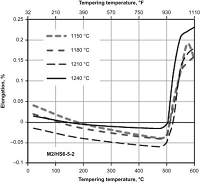
High-speed steels show a typical distortion behavior depending on the heat treatment parameters. The figure shows the change in length of cylindrical bars (diameter = 20 mm, or 0.8 in.) and length = 140 mm, or5.5 in.), with rolling direction longitudinal to the sample) for various heat treatment conditions with austenitizing, salt bath quenching, and double tempering.
Quenching and tempering up to 500 °C (930 °F) results only in very small changes in length (either growth or shrinking). Higher tempering temperatures lead to a transformation of the retained austenite into martensite and a corresponding growth in length. For typical tempering temperature of 560 °C (1040 °F) changes in length of about 0.2% take place. Additional alloying with Co (5%) leads to slightly higher changes in length. The effect of an additional third tempering shifts the curve slightly to the left, whereas oil quenching leads to a slight reduction of the change in length.
For more information, click on the link below (subscription required). Then scroll to Figure 9. R Schneider; R. Mesquita; W Schützenhöfer, Distortion in Tool Steels, ASM International, 2014 https://doi.org/10.31399/asm.hb.v04d.a0005980