Materials science engineers often struggle to design materials that are strong in all directions, as strengthening them for one type of load can create weaknesses for another. To address this, Binghamton University Assistant Professors Mir Jalil Razavi and Dehao Liu are using artificial intelligence and machine learning to develop composite materials with specific mechanical properties. Their project, supported by a $313,087 grant from the National Science Foundation, aims to create a deep-learning model that customizes the microarchitecture of these materials based on physical laws.
“When we look at materials now, we usually tune mechanical properties in one direction,” Razavi said. “For example, they can absorb the shock in ‘x’ direction, but they don’t pay attention to what will happen to the ‘y’ or ‘z’ direction. While we strengthen in one direction, maybe we’ll compromise their mechanical properties in the other directions.”
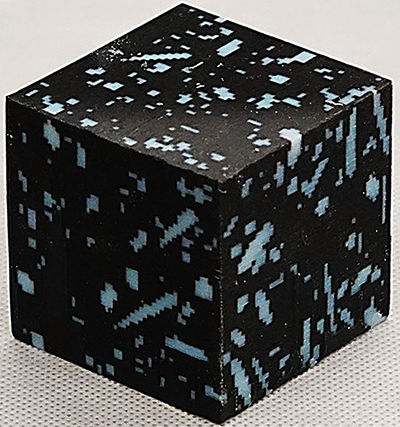
“Imagine trying to mix two types of materials,” Liu said. “One is very solid and stiff. One is very soft, like if you mix stone and gel and then glue them together. How can you design the distribution of the stone and the gel? They can show different mechanical properties at different directions.”
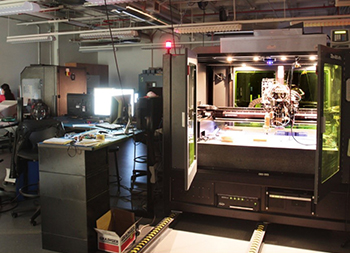
Razavi and Liu will develop thousands of mechanical computational models to train deep learning algorithms in designing composite materials tailored to specific needs. They will decide which suggestions are most promising, and their collaborator, Associate Professor Yanyu Chen from the University of Louisville (Kentucky), will validate the best combinations through additive manufacturing (3D printing), X-ray imaging and stress testing.
“With this research, the goal would be that you give the material properties you are seeking in that different direction, and I inversely fabricate the material for you,” Razavi said.
The idea for the project originated from Razavi’s research on the human brain. He hopes to chart the formation of brain folds as faster-growing grey matter (the outer layer where higher-level thinking is done) grows on top of white matter (the inner layer that communicates between different gray matter areas and between the gray matter and the rest of the body).
“Because brain tissue has different fiber tracts, it shows different mechanical properties in different directions,” he said. “When we want to fully characterize brain tissue, we need multiple loading cases to analyze that.”
The Binghamton team believes this machine learning research could revolutionize materials design and enable the rapid development of new materials with tailored properties for a wide range of applications, such as designing lighter structures, effective shock absorbers and aerospace components.
“It could be used not just in advanced areas like the brain, but also everyday materials like helmets and shoes,” Liu said. “If your shoes don’t feel comfortable, you can design your own personal pair using materials with different mechanical properties.”
For more information: Binghamton University