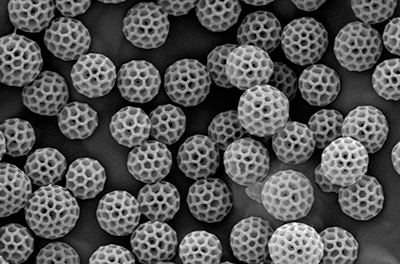
A recent study may provide insights into the distinctive coating on leafhoppers’ skin, potentially inspiring the creation of innovative new materials. Leafhoppers, which encompass over 20,000 small insect species, are adorned with hollow, soccer ball–shaped nanoparticles composed of proteins and lipids. These nanoparticles, known as “brochosomes,” were first identified in the 1950s. They help the insects’ skin repel water and minimize light reflection. The exact shape and size of brochosomes vary among different species.
Elizabeth Bello, a graduate student in Marianne Alleyne’s entomology lab at the University of Illinois Urbana-Champaign, applied techniques developed by materials scientists to pick up brochosomes individually, compress them, and study their mechanical properties. The balls’ size, shape, and material properties determine how well they resist compression and cling to surfaces, Alleyne reported earlier this month at the annual meeting of the Society for Integrative and Comparative Biology. Further study of brochosomes could help the development of materials with a wide range of applications, including waterproofing, camouflage, self-cleaning surfaces, and even data encryption and anticounterfeiting devices.
For more information: Science Advances