In a paper published in Science, Stanford researchers show that niobium phosphide can conduct electricity better than copper in films that are only a few atoms thick. Moreover, these films can be created and deposited at sufficiently low temperatures to be compatible with modern computer chip fabrication. Their work could help make future electronics more powerful and more energy efficient.
As computer chips continue to get smaller and more complex, the ultrathin metallic wires that carry electrical signals within these chips have become a weak link. Standard metal wires get worse at conducting electricity as they get thinner, ultimately limiting the size, efficiency, and performance of nanoscale electronics.
“We are breaking a fundamental bottleneck of traditional materials like copper,” said Asir Intisar Khan, who received his doctorate from Stanford and is now a visiting postdoctoral scholar and first author on the paper. “Our niobium phosphide conductors show that it’s possible to send faster, more efficient signals through ultrathin wires. This could improve the energy efficiency of future chips, and even small gains add up when many chips are used, such as in the massive data centers that store and process information today.”
Niobium phosphide is a topological semimetal, which means that the whole material can conduct electricity, but its outer surfaces are more conductive than the middle. As a film of niobium phosphide gets thinner, the middle region shrinks but its surfaces stay the same, allowing the surfaces to contribute a greater share to the flow of electricity and the material as a whole to become a better conductor. Traditional metals like copper, on the other hand, become worse at conducting electricity once they are thinner than about 50 nanometers.
The researchers found that niobium phosphide became a better conductor than copper at film thicknesses below 5 nanometers, even when operating at room temperature. At this size, copper wires struggle to keep up with rapid-fire electrical signals and lose a lot more energy to heat.
“Really high-density electronics need very thin metal connections, and if those metals are not conducting well, they are losing a lot of power and energy,” said Eric Pop, the Pease-Ye Professor in the School of Engineering, a professor of electrical engineering, and senior author on the paper. “Better materials could help us spend less energy in small wires and more energy actually doing computation.”
Many researchers have been working to find better conductors for nanoscale electronics, but so far the best candidates have had extremely precise crystalline structures, which need to be formed at very high temperatures. These niobium phosphide films are the first examples of non-crystalline materials that become better conductors as they get thinner.
Because the niobium phosphide films don’t need to be single crystals, they can be created at lower temperatures. The researchers deposited the films at 400 degrees Celsius, a temperature that is low enough to avoid damaging or destroying existing silicon computer chips.
“If you have to make perfect crystalline wires, that’s not going to work for nanoelectronics,” said Yuri Suzuki, the Stanley G. Wojcicki Professor in the School of Humanities and Sciences, a professor of applied physics, and co-author on the paper. “But if you can make them amorphous or slightly disordered and they still give you the properties you need, that opens the door to potential real-world applications.”
Although niobium phosphide films are a promising start, Pop and his colleagues don’t expect them to suddenly replace copper in all computer chips – copper is still a better conductor in thicker films and wires. But niobium phosphide could be used for the very thinnest connections, and it paves the way for research into conductors made of other topological semimetals. The researchers are already looking into similar materials to see if they can improve niobium phosphide’s performance.
Pop and his team are also working on turning their niobium phosphide films into narrow wires for additional testing. They want to determine how reliable and effective the material could be in real-world applications.
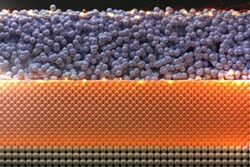
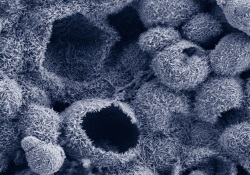
Image – A film a few atoms thick of non-crystalline niobium phosphide conducts better through the surface to make the material, as a whole, a better conductor. Courtesy of: Il-Kwon Oh / Asir Khan.
For more information
Stanford Engineering
https://engineering.stanford.edu/