The U.S. Department of Energy (DOE) announced $179 million in funding over four years for three Microelectronics Science Research Centers (MSRCs), authorized by the Micro Act in the CHIPS and Science Act of 2022. These centers will conduct basic research in microelectronics materials, device and system design, and manufacturing science to transform future microelectronics technologies. The MSRCs, formed as networks of 16 projects led by 10 national laboratories, complement activities under the CHIPS and Science Act at the Department of Commerce, the Department of Defense, and other agencies.
The Microelectronics Energy Efficiency Research Center for Advanced Technologies (MEERCAT) will advance integrated innovations across materials, devices, information-carrying modalities, and systems’ architectures. Focusing on intelligent sensing, data bandwidth, multiplexing, and advanced computing, the center will explore transformative solutions that seamlessly bridge sensing, edge processing, artificial intelligence, and high-performance computing.
The Co-design and Heterogeneous Integration in Microelectronics for Extreme Environments (CHIME) Center will develop extreme environment electronics through heterogeneous integration and a seamless fusion of diverse materials, processes, and technologies to enable next-generation systems. The center will create robust, high-performance solutions capable of excelling in the most challenging conditions, including extreme thermal and radiation environments.
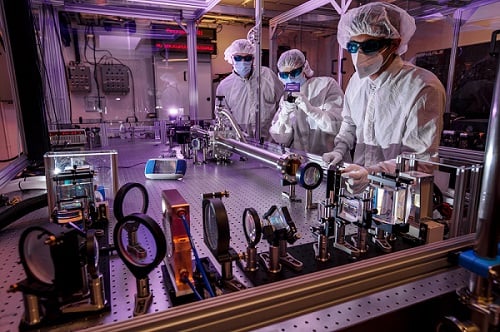
The Extreme Lithography & Materials Innovation Center (ELMIC) aims to advance the fundamental science driving the integration of new materials and processes into future microelectronic systems, focusing on key areas such as plasma-based nanofabrication, extreme UV photon sources, 2D-material systems, and extreme-scale memory. The center’s scientific investigations will be informed strongly by a systems-to-physics motivation aimed at long term impact.
For more information: U.S. Department of Energy
Image: (From left) Lawrence Livermore National Laboratory researchers Drew Willard, Brendan Reagan, and Issa Tamer work on the Big Aperture Thulium laser system, one of the projects designated under the Extreme Lithography & Materials Innovation Center.