A team of researchers, led by the University of Massachusetts Amherst, made an important discovery in their quest to design the next generation of materials for modern devices—ones that are lightweight, flexible, and excellent at dissipating heat: imperfection has its upsides.
This researchers found that polymers (specifically plastics) made with thermally conductive fillers containing defects performed 160% better than those with perfect fillers. The study was led by UMass Amherst with collaborators from Massachusetts Institute of Technology, North Carolina State University, Stanford University, Oak Ridge National Laboratory, Argonne National Laboratory, and Rice University.
Polymers have revolutionized modern devices with their unmatched lightness, electrical insulation, flexibility and ease of processing—qualities metals and ceramics simply can’t rival.
However, common polymers are thermal insulators with low thermal conductivity, which can lead to overheating issues. Their inherent insulating properties trap heat, spawning dangerous hot spots that sap performance and accelerate wear, heightening the risk of catastrophic failures and even fires.
For years, scientists have attempted to enhance the thermal conductivity of polymers by incorporating highly thermally conductive fillers such as metals, ceramics or carbon-based materials. The logic is straightforward: blending in thermally conductive fillers should improve overall performance.
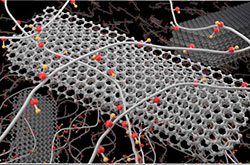
For their study, aimed at laying the foundation for understanding thermal transport in polymeric materials and controlling heat transfer across heterogeneous interfaces, the team created two polymer composites of polyvinyl alcohol (PVA)—one incorporating perfect graphite fillers and the other using defective graphite oxide fillers, each at a low 5% volume fraction.
As expected, the perfect fillers on their own were more thermally conductive than imperfect ones. However, surprisingly, when these fillers are added into polymers, polymers made with graphite oxide fillers containing defects performed 160% better than those with perfect graphite fillers.
They found that defective fillers facilitate more efficient heat transfer because their uneven surfaces don’t allow the polymer chains to pack together as tightly as the perfectly smooth fillers do. This unexpected effect, known as enhanced vibrational couplings between the polymers and defective fillers at the polymer/filler interfaces, boosts thermal conductivity and reduces resistance, making the material more efficient at transferring heat.
These advancements present new opportunities for devices—from high-performance microchips to next-generation soft robotics—to operate cooler and more efficiently through improved heat dissipation.
Image – Illustration shows polymers (the long tubes) filled with perfect (top, graphite) or imperfect (bottom, graphite oxide) fillers. Courtesy of Yijie Zhou/UMass Amherst.
************
For more information:
University of Massachusetts Amherst