Researchers from the U.S. Army Research Laboratory and Lehigh University have developed a nanostructured copper alloy (Cu-Ta-Li) with exceptional thermal stability and mechanical strength, potentially redefining high-temperature materials for aerospace, defense, and industrial applications. This groundbreaking alloy is one of the most resilient copper-based materials ever created. The research, supported by a $25 million cooperative agreement and Lehigh’s Presidential Nano-Human Interfaces Initiative, highlights the decade-long partnership between Lehigh and ARL in advancing materials science.
“This is cutting-edge science, developing a new material that uniquely combines copper’s excellent conductivity with strength and durability on the scale of nickel-based superalloys,” said Martin Harmer, the Alcoa Foundation Professor Emeritus of Materials Science and Engineering at Lehigh and a co-author of the study. “It provides industry and the military with the foundation to create new materials for hypersonics and high performance turbine engines.”
The ARL and Lehigh researchers collaborated with scientists from Arizona State University and Louisiana State University to develop the alloy, which can withstand extreme heat without significant degradation.
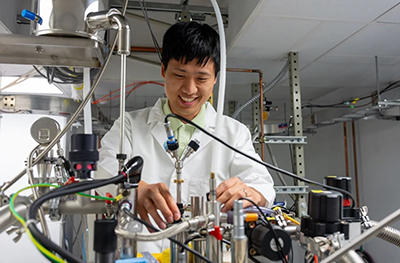
This and other innovative alloys will continue to be studied in Lehigh’s newly outfitted high-tech research labs, the Nanoalloy Lab and Nanoceramics Lab, which include high-pressure torsion systems, nanoindentation equipment and specialized high-temperature furnaces.
The breakthrough comes from the formation of Cu₃Li precipitates, stabilized by a Ta-rich atomic bilayer complexion, a concept pioneered by the Lehigh researchers. Unlike typical grain boundaries that migrate over time at high temperatures, this complexion acts as a structural stabilizer, maintaining the nanocrystalline structure, preventing grain growth and dramatically improving high-temperature performance.
The alloy holds its shape under extreme, long-term thermal exposure and mechanical stress, resisting deformation even near its melting point, noted Patrick Cantwell, a research scientist at Lehigh University and co-author of the study.
By merging the high-temperature resilience of nickel-based superalloys with copper — which is known for exceptional conductivity — the material paves the way for next-generation applications, including heat exchangers, advanced propulsion systems and thermal management solutions for cutting-edge missile and hypersonic technologies.
This new Cu-Ta-Li alloy offers a balance of properties not found in existing materials:
- Nickel-based superalloys (used in jet engines) are extremely strong but lack the high thermal conductivity of copper alloys.
- Tungsten-based alloys are highly heat-resistant but dense and difficult to manufacture.
- This Cu-Ta-Li alloy combines copper’s exceptional heat and electrical conductivity while remaining strong and stable at extreme temperatures.
- While not a direct replacement for traditional superalloys in ultra-high temperature applications, it has the potential to complement them in next-generation engineering solutions.
The team synthesized the alloy using powder metallurgy and high-energy cryogenic milling, ensuring a fine-scale nanostructure. They then subjected it to:
- 10,000 hours (over a year) of annealing at 800°C, testing its long-term stability.
- Advanced microscopy techniques, revealing the Cu₃Li precipitate structure.
- Creep resistance experiments, confirming its durability under extreme conditions.
- Computational modeling using density functional theory (DFT), which validated the stabilizing role of the Ta bilayer complexion.
A project such as this takes years of careful work and collaboration, said Christopher Marvel ’12 ’16 Ph.D., an author of the paper and professor of mechanical engineering at Louisiana State University.
“Lehigh has such a strong reputation for electron microscopy, and that is what interested the ARL in working with us on this material. It was our microscopy that was really key to understanding the material,” said Marvel, who helped lead that portion of the research over a six-year period. “The Lehigh faculty have worked on many high-level research projects over the years, and they’ve all taught me different things that I apply now as an academic.”
The ARL was awarded a U.S. patent (US 11,975,385 B2) for the alloy, highlighting its strategic significance, particularly in defense applications like military heat exchangers, propulsion systems and hypersonic vehicles.
Further research will include direct measurements of the alloy’s thermal conductivity compared to nickel-based alternatives, work to ready it for potential applications, and the development of other high-temperature alloys following a similar design strategy.
For more information: Science
Image: This groundbreaking nanostructured copper alloy that could redefine high-temperature materials for aerospace, defense and industrial applications.