A multi-disciplinary team published a paper in Nature Electronics and the achievement was one of the most elusive goals in microwave electronics.
For more than two decades, scientists searching for better materials for wireless electronics have faced a seemingly unavoidable tradeoff: A material could be tunable – able to change its electrical properties on demand by applying a voltage – or efficient, losing very little energy as heat. Getting both properties at once could improve components used in wireless communications, radar systems, satellites and other devices that rely on controlling microwave signals with precision.
The layered crystalline materials, known as Ruddlesden-Popper thin films, were prized for exceptionally low energy loss at microwave frequencies. But according to the accepted understanding of their crystal symmetry, they shouldn’t have been able to provide the tunability needed for practical devices.
While it was an exciting and scientifically interesting finding, the material was commercially impractical. The effect only appeared in an in-plane geometry, in which the electric field moved sideways through the material. Real-world devices such as voltage-tunable capacitors used in microwave circuits generally require an out-of-plane design, in which the electric field moves vertically through the film, enabling smaller, more efficient components.
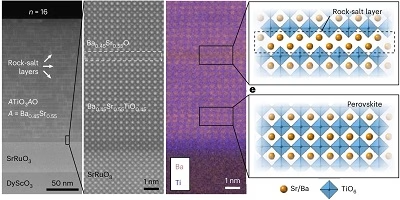
Working with collaborators at Cornell, the University of Connecticut, Rice University, the University of Maryland, Boise State University and the National Institute of Standards and Technology, Darrell Schlom, the Tisch University Professor in Cornell University’s Department of Materials Science and Engineering, and his doctoral student at the time, Matthew R. Barone, Ph.D. ’22, engineered a new version of the material by inserting carefully spaced rock-salt layers. The strategy effectively rewrote the material’s internal rules, allowing it to exhibit the out-of-plane behavior needed for practical devices while preserving the low-loss characteristics that had made the Ruddlesden-Popper thin films attractive in the first place.
That result was an important clue, but it was not enough. Low-frequency measurements had shown that the material could be coaxed into the right kind of electrical behavior. What the team still needed to know was whether it would deliver that same tunability with low loss at the high microwave frequencies relevant for practical devices.
The frequencies most relevant for modern communications systems are among the most difficult to measure accurately because at those high frequencies, the signal from the material can be distorted by the test structure itself – the metal electrodes, wiring and geometries surrounding the dielectric. So when the researchers first tested the new Ruddlesden-Popper devices at microwave frequencies, the results were confusing.
“The secret to how we made the measurement work is we measured nothing,” said Florian Bergmann, a physicist at the National Institute of Standards and Technology and co-first author on the study. “We measured a control – a sheet of metal that had the same topology as the device.”
Measuring that control structure let the team perform an additional round of calibration, subtracting away distortions caused by the test structure itself and isolating the dielectric’s true microwave response. The result transformed what had looked like noisy, incomprehensible data into something meaningful.
With Schlom, Nate Orloff, a physicist at the National Institute of Standards and Technology, and their colleagues, those measurements became the centerpiece of the team’s Nature Electronics paper confirming what the researchers had hoped for years: Their material combined strong tunability with exceptionally low microwave loss in an out-of-plane geometry relevant to real devices. They had found the holy grail.
The material itself could eventually find applications in tunable filters and quantum information systems. Orloff said two especially promising directions are microwave resonators and electro-optic modulators, devices that help convert electrical signals into optical ones for communications networks.
Image – Researchers used advanced microscopy to confirm the atomic structure of an engineered Ruddlesden-Popper material. The diagrams show how alternating layers in the crystal helped produce the material’s unusual combination of tunability and low energy loss. Courtesy of: Noah Schnitzer, Ph.D. ’25; Lopa Bhatt, doctoral student; and David Muller, the Samuel B. Eckert Professor in the School of Applied and Engineering Physics.
For more information:
Cornell University
https://www.cornell.edu/