Researchers at the University of Minnesota Twin Cities have, for the first time, demonstrated that Minnesota’s abundant low-grade iron ore can be converted into semiconductor-quality pyrite, also known as iron sulfide or “fool’s gold.” The breakthrough could open the door to more cost-effective and sustainable electronic devices by transforming a widely available natural resource into a valuable semiconductor material. Because pyrite is inexpensive, non-toxic and highly effective at absorbing light, it has significant potential for future technologies, and this research shows that Minnesota’s iron ore resources may provide a viable pathway for producing high-quality semiconductor materials despite the challenges posed by impurities and defects.
In this work the researchers took iron ore samples directly from the Minnesota Iron Range and demonstrated that they can be used to synthesize semiconductor-quality fool’s gold using simple processes. This discovery took the researchers by surprise.
“We realized that pyrite’s really not like a typical semiconductor – it is surprisingly immune to impurities,” said Chris Leighton, Distinguished McKnight University Professor in the Department of Chemical Engineering and Materials Science and senior author on the paper. “So, we wondered, do we even need the high purity material that we (and everyone else) had been using to make semiconducting pyrite.”
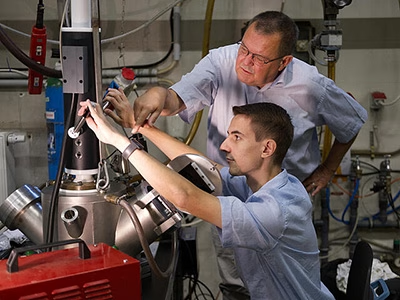
The researchers were able to test three different types of iron ore in this process. It turns out that the one that works best — Direct Reduced Grade Taconite — is one of the most commonly used grades available in Minnesota.
“There are all sorts of reasons why you would think this would not be possible,” Leighton added. “But, during processing the dirty — or low-purity — iron ores, directly from the Minnesota Iron Range, were easily converted to semiconductor-quality pyrite with no extra purification steps. This happens for reasons that we now understand pretty well.”
This discovery could open up a new revenue stream for a global industry, with a broad spectrum of applications in clean energy technologies, based on a natural resource found abundantly in Minnesota.
Future applications of this research could arise in batteries, solar panels, electronics and processes to purify water. The team hopes to continue this research by testing additional types of iron ores, as they come in a vast variety of grades. They would also focus on making not bulk crystals of pyrite with these Iron Range resources, but also thin film samples more closely relevant to devices.
In addition to Leighton, the research team included Yeon Lee and Caitlyn Komar from the Department of Chemical Engineering and Materials Science, Jennifer T. Mitchell from the University of Minnesota Characterization Facility and the Department of Earth and Environmental Sciences, along with Matt Mlinar, Jestos Taguta and George Hudak from the University of Minnesota Natural Resources Research Institute.
For more information: Physical Review Applied
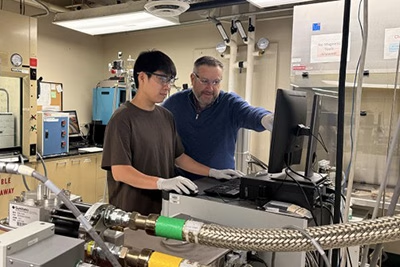
Image: Professor Chris Leighton (right) and graduate student Yeon Lee (left) have demonstrated that a certain grade of iron ore found in Minnesota could be the key to the sustainability of future electronics.