With a twist between layers of graphene, scientists supported by the DOE’s Office of Science created the foundation for twistronics.
In 2009, a team led by Eva Andrei at Rutgers University supported by the Department of Energy’s (DOE) Office of Science started researching stacked layers of two-dimensional materials. Two-dimensional materials are only a single atom thick. They have bizarre properties compared to their thicker cousins, for example, graphene. What Andrei’s team found led to a whole new field of research in physics, called twistronics.
The prestigious Kavli Prize in Nanoscience recently recognized Andrei as well as Pablo Jarillo-Herrero and Allan H. MacDonald for their contributions. Together, these award-winning scientists laid the foundations for work that researchers at DOE’s National Laboratories and other institutions are pursuing today.
Andrei and her team were interested in graphene because of the unusual way electrons move within it. In the early days of graphene research, many materials scientists thought electrons didn’t interact very much in graphene, like in most materials. Andrei’s team found evidence otherwise.
Big changes in the density of state can indicate changes in how electrons are moving in a material. That’s what Andrei and her group saw in the stacked layers of graphene – although it was completely by accident.
When Andrei and her group sought to study graphene as part of the study supported by DOE’s Office of Science, they expected to be examining a single sheet. The original aim was to study a large sample of graphene with a transmission electron microscope.
Andrei’s group received their sample, however the person who created it at the Massachusetts Institute of Technology (MIT) used a base made of nickel instead of copper. Coincidentally, that change produced multiple stacked layers of graphene. As Andrei said in her personal reflection for the Kavli Award, “What we saw was a complete surprise—not even close to what we expected.” Moreover, each layer was off from the other just a little bit. The graphene production had accidentally produced moiré patterns.
The existence of moiré patterns in graphene wasn’t new. But what the team did next was – they started investigating the patterns’ electronic properties. They found that the band structure – the bands and band gaps in the material – was very different in the twisted bilayer graphene than in the single sheet. That meant the electronic structure would be different too.
Because the material had layers at different angles from each other, the team could study the effects of these angles on the electronic structure. They discovered one particular twisted angle – 1.07 degrees – that had a strangely “flat” electronic band. In these bands, energy levels are squeezed together. As a result, far more electrons can occupy the same energy level than usual. This radical increase in density of state is associated with electrons moving in a coordinated way.
This collective action is in contrast to electrons’ usual disorganized movement. Strongly interacting electrons lead to a number of strange quantum properties. One of these properties is superconductivity. Figuring out how to create superconducting materials that work near or at room temperature would expand the possible applications for superconductors.
But first, physicists had to understand why it happens. In 2011, Allan H. MacDonald’s team at the University of Texas at Austin developed a theoretical model of this phenomenon. This analysis helped scientists understand what barriers stood in the way of manipulating these 2D layers.
In 2018, Pablo Jarillo-Herrero and his group at MIT built on Andrei’s discovery. Recreating parts of the initial discovery, they twisted sheets of graphene to the “magic angle” of 1.07 degrees. With more in-depth experimentation, they demonstrated that this angle resulted in unconventional superconductivity. His team also discovered correlating insulating states, where electrons act in tandem but stop moving.
Since then, the field of “twistronics” has exploded. It offers potential breakthroughs in computing, quantum sciences, and designing custom materials. It allows scientists to control how electrons move through a material by altering its geometry. This finding opens the door to designing smaller and more efficient devices. It could also be an important aspect of more reliable energy storage. Because of moiré superlattices’ quantum properties, they could also be important for quantum computers and other quantum technology.
*************************************************************************************************
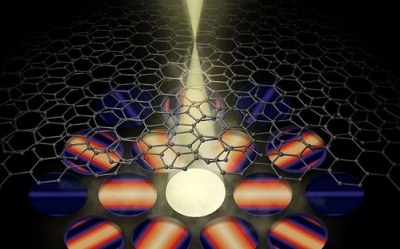
Image – The structure is a twisted bilayer of graphene, the material that Eva Andrei’s team first studied. The illustration shows a technique developed by scientists at DOE’s Oak Ridge National Laboratory to better measure these materials. Courtesy of: Oak Ridge National Laboratory.
For more information:
DOE Office of Science
https://www.energy.gov/science/office-science