The race for more powerful AI chips is increasingly shifting to packaging. To pack more computing power into a smaller space in the future, industry leaders are therefore investing in new substrate technologies such as glass substrates. These enable more functions to be integrated into a smaller space and allow data to be transmitted faster and more efficiently within the chip. To achieve this, however, manufacturers must drill millions of microscopic holes into the glass and then coat them with conductive material.
TRUMPF, Germany, has now developed the first industrial process of its kind that enables the production of such structures with high quality and reproducible results. With its HiPIMS products, the high-tech company is supporting the semiconductor industry in bringing glass substrates for the next generation of high-performance AI processors to series production.
“The computing power of modern AI chips is increasing rapidly. As a result, the demand for packaging is also growing. Through-glass vias are considered a promising approach for future generations of chips. However, it is crucial that millions of extremely fine structures can be reliably coated. This is exactly where our HiPIMS technology comes into play,” says Piotr Lach, head of Next Technology Demands at TRUMPF Elektronik. The challenge: The holes in the glass substrates are both very deep and very narrow. Even a small number of incorrectly coated through-vias can render an entire glass panel unusable.
For mass production, therefore, reliable processes, consistent results, and a high yield of functional components are crucial. TRUMPF’s technology improves process stability and increases production yield compared to conventional methods. This enables TRUMPF to help chip manufacturers economically transition new packaging concepts for AI applications into series production.
HiPIMS is a particularly high-performance coating process. TRUMPF’s industrially manufactured HiPIMS generators produce a highly-ionized plasma with a higher proportion of electrically charged particles than conventional methods. These ions can be precisely controlled using additional electric and magnetic fields and directed into deep, narrow structures. This results in a significantly more uniform coating, even in deep trenches.
HiPIMS generates significantly higher ionization, leading to a higher density of deposited molecules. “This improves the quality of the coating. The technology helps increase manufacturing yield and lays the foundation for cost-effective mass production of future AI chips,” says Lach.
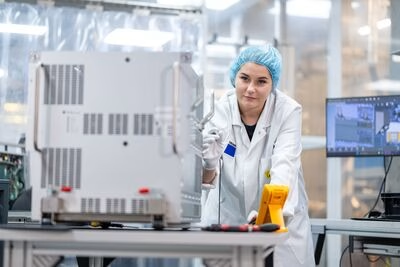
Image – Testing the parameters of plasma generators at TRUMPF’s research and development laboratories in Zielonka, Poland. Courtesy of: TRUMPF.
For more information:
TRUMPF
https://www.trumpf.com