
Critical minerals and materials are essential to everyday technology, energy systems, national defense, advanced manufacturing and innovation. The U.S. National Science Foundation Directorate for Geosciences invests in research to improve how these materials are discovered and studied while preparing the next generation of researchers.
Here are a few examples of projects supported by these investments over the past year.
Researchers from the Colorado School of Mines are working with industry partners to study the conditions necessary for copper to form in economically viable concentrations at Copper Creek in Arizona.
The project will determine when and at what temperature copper precipitates among three different ore types. The team will conduct field investigations and examine drill core samples using petrography, cathodoluminescence microscopy, and fluid inclusion analysis to provide new insights into the spatial and timing controls on processes that form metals in porphyry copper deposits.
The work will provide support for graduate student training in leading-edge, use-inspired economic geology education and research.
A team from Washington State University is studying chemical changes in hot fluids from a carbonatite-hosted rare earth element (REE) deposit at Mountain Pass, California, to provide geologic context for the timing and evolution of the fluids that produced the REE-enriched geologic formation.
These types of deposits can be difficult to detect at Earth’s surface. The project will expand beyond the primary REE deposit to examine the spatial extent and chemistry of the surrounding “alteration halo” — rocks that have experienced distinct changes in their chemistry that can help “fingerprint” where the REE-enriched rocks are located and the conditions under which they formed.
This project will help researchers and industry focus exploration efforts on additional REE-enriched geologic sources.
Researchers from the New Mexico Institute of Mining and Technology are exploring ways CMM forms in hydrothermal fluids, such as those found in geysers, mud pots, and fumaroles. The team will use thermodynamic models, across a range of pressures and temperatures, to predict conditions in which CMM form in hydrothermal fluids.
Researchers will also determine thermodynamic properties of CMM-bearing hydrothermal fluids and apply these new thermodynamic tools to model natural geothermal systems. Workshops and student internships will provide training opportunities in cutting-edge thermodynamic modeling to improve understanding of CMM formation.
Another group of researchers from Boise State University is developing a rapid, cost-effective prospecting tool for strategic metals using trace elements from different tree species.
The team will compare trace elements in three common mid-elevation evergreen tree species with measurements in nearby soils to determine whether the tree samples can help pinpoint CMM deposits. The team, made up of graduate and undergraduate students, will use laser-ablation, inductively coupled plasma, mass spectrometer analyses to quickly and precisely measure the trace element concentrations in trees.
If successful, this approach would simplify and expand how people prospect for critical minerals in wooded areas.
A research team led by Woods Hole Oceanographic Institution is taking a cutting-edge approach to an established field to find deep-sea sediments enriched in REEs, a subset of CMM used for magnets, catalysts, and many military assets.
Deep-sea clays contain a lot of fish fossils, fish teeth, and shark scales. These long-buried deep-sea creatures have visually identifiable morphological characteristics tied to specific intervals of geologic time, allowing researchers to match the age of the fossil with the age of the surrounding sediment through a field called ichthyolith biostratigraphy.
The research team will use machine learning-driven image classification to significantly advance ichthyolith biostratigraphy, which can in turn enhance super intelligence- and statistics-driven interpolation of sparse data from remote parts of the Pacific Ocean. The outcome can improve predictions on where to find REE-rich deposits.
A collaborative award to the University of Minnesota and Oregon State University will expand use of the Magnetics Information Consortium (MagIC) database, a digital data archive of rock magnetism.
The public database allows researchers to investigate the magnetic properties of Earth materials, supporting the study of changes to Earth’s protective magnetic field over time, pinpointing mineral deposits, and understanding how long-term tectonic motions relate to volcanic and earthquake activity.
MagIC catalogs the magnetic properties of different rock types identified through studies prospecting for critical minerals. The database will serve as a resource for critical mineral exploration. MagIC also stores information about tectonic plate motions, helping researchers predict where ancient tectonic processes may have formed rich deposits of REEs and other strategic minerals.
A cooperative agreement with the University of Minnesota will continue to support the long-term operations and management of the Continental Scientific Drilling Facility (CSDF).
CSDF provides key resources and project support for researchers who need to access the subsurface to collect samples by drilling and coring. These tools are the primary means of accessing, measuring, and monitoring processes that operate at depth and form CMM.
Under the current award, the CSDF will stimulate community science planning and support new projects across the Earth Sciences, including studies of CMM. Recent CSDF-supported projects have examined the tectonic and geochemical controls on active-fault hydrogeology, providing insights into the environments and processes linked to critical mineral formation.
A new NSF Research Experience for Undergraduates (NSF REU) site led by Miami University will provide undergraduate students with hands-on summer research opportunities covering three themes: Soil, Water, and Atmospheric Systems; Hazards and Resource Preservation; and Critical Minerals. The NSF REU site aims to address the need for a science, technology, engineering, and mathematics-ready workforce.
Students will conduct a 10-week, independent, faculty-mentored research project associated with one of the themes. Those working on the critical minerals theme can explore potential domestic sources of chromium, cobalt, and nickel associated with ultramafic rocks, as well as opportunities to recycle historic mine waste from gold-silver mining operations. During the summer experience, students will also gain career exposure through connections with real-world practitioners in the critical minerals space.
A multi-institute team led by Syracuse University is supporting eRock, an open digital platform that makes outcrop data easier to find, explore, analyze, and share.
The team will be investigating how geological processes control the movement and concentration of lithium in Earth’s crust. This work could improve exploration strategies and strengthen domestic supplies of a mineral critical to the energy transition.
This project will also create a transformational, browser-based analytical environment that integrates measurement, interpretation, and contextual metadata in one open platform. The platform uses drone photography, 3D imaging, and web-based visualization tools to allow scientists to remotely study the geological structures that host REEs and transition materials like lithium.
By improving access to digital field data, the project will strengthen geoscience research and help prepare the next generation of geoscientists with modern digital skills.
For more information: National Science Foundation
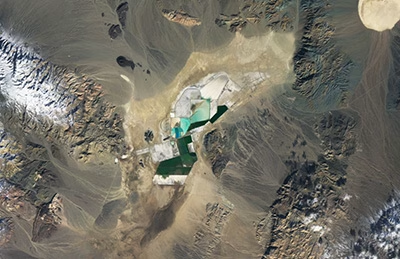
Image: The Operational Land Imager-2 (OLI-2) on Landsat 9 acquired this natural-color image of the lithium mining operation in Silver Peak, Nevada, on December 8, 2022. The Silver Peak mine generates about 1 percent of the world’s annual production of lithium. Credit: NASA Earth Observatory image by Lauren Dauphin, using Landsat data from the U.S. Geological Survey