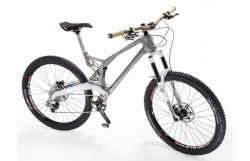
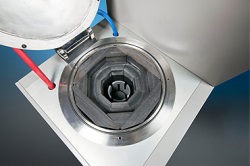
Renishaw, U.K., has collaborated with a leading British bicycle design and manufacturing company to create the world’s first 3D printed metal bike frame. During the build process, a high-power ytterbium fiber laser selectively fused particles of a titanium alloy powder. Combining layer upon layer formed the finished 3D printed bike frame sections, which were then bonded together to make the frame.
Empire Cycles designed the mountain bike to take advantage of Renishaw’s additive manufacturing technology, allowing them to create a titanium frame that would be both strong and light via topological optimization. The new frame is some 33% lighter than the original aluminum version.
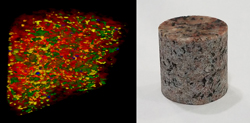
Titanium alloys have a high ultimate tensile strength (UTS) of more than 900 MPa when processed by additive manufacturing, and near perfect density of greater than 99.7%. This is better than casting and, as any porosity is both small and spherical, it has little effect on strength.
The project’s aim is to produce a fully functioning bicycle, so the seat post bracket was tested using the mountain bike standard EN 14766; it withstood 50,000 cycles of 1200 N. Testing continued to six times the standard without failure. The original aluminum alloy seat post bracket is 360 g and the hollow titanium version is 200 g, a weight saving of 44%. Renishaw originally agreed to optimize and manufacture the seat post bracket only, but after this proved successful, decided the whole frame was a practical goal.
Testing of the completed bicycle frame will continue, both in the laboratory using Bureau Veritas UK, and on the mountainside using portable sensors in partnership with Swansea University.
www.renishaw.com