Scientists from General Atomics, San Diego, and the U.S. DOE’s Princeton Plasma Physics Laboratory (PPPL), N.J., discovered a phenomenon that helps improve fusion plasmas, which could ultimately speed fusion energy development. Together with a team of researchers from across the U.S., scientists found that when tiny grains of lithium were injected into a plasma undergoing a particular kind of turbulence, under the right conditions, both temperature and pressure rose dramatically. High heat and pressure are crucial to fusion, a process in which atomic nuclei—or ions—smash together and release energy—making even a brief rise in pressure significant in fusion energy development.
“These findings might be a step towards creating our ultimate goal of steady-state fusion, which would last not just for milliseconds, but indefinitely,” says Tom Osborne, a physicist at General Atomics. This work was supported by the DOE Office of Science (Office of Fusion Energy Sciences).
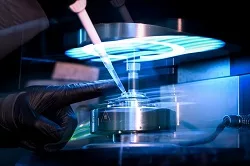
A device developed at PPPL was used to inject grains of lithium measuring some 45 millionths of a meter in diameter into a plasma in the DIII-D National Fusion Facility—or tokamak—that General Atomics operates for DOE in San Diego. When lithium was injected while the plasma was relatively calm, the plasma remained basically unaltered. Yet when the plasma was undergoing a kind of turbulence known as a “bursty chirping mode,” the lithium injection doubled the pressure at the outer edge of the plasma. In addition, the length of time that the plasma remained at high pressure rose by a factor greater than 10.
Experiments have sustained this enhanced state for up to one-third of a second. A key scientific objective will be to extend this enhanced performance for the full duration of a plasma discharge. Physicists have long known that adding lithium to a fusion plasma increases its performance. The new findings surprised researchers, however, because the small amount of lithium raised the plasma’s temperature and pressure more than expected.
“Results could represent the birth of a new tool for influencing or perhaps controlling tokamak edge physics,” says Dennis Mansfield, a physicist at PPPL who helped develop the injection device called a “lithium dropper.” Also working on the experiments were researchers from Lawrence Livermore National Laboratory, Oak Ridge National Laboratory, University of Wisconsin-Madison, and University of California-San Diego.
Conditions at the plasma’s edge have a profound effect on its superhot core where fusion reactions take place. Increasing pressure at the edge region raises the plasma’s pressure as a whole. And the greater the plasma pressure, the more suitable conditions are for fusion reactions. “Making small changes at the plasma’s edge lets us increase the pressure further within the plasma,” says Rajesh Maingi, manager of edge physics and plasma-facing components at PPPL.
Further experiments will test whether lithium’s interaction with the bursty chirping modes—so-called because the turbulence occurs in pulses and involves sudden changes in pitch—caused the unexpectedly strong overall effect. PPPL is devoted to creating new knowledge about the physics of plasmas—ultra-hot, charged gases—and development of practical solutions to create fusion energy. Results of PPPL research range from a portable nuclear materials detector for anti-terrorist use, to universally employed computer codes for analyzing and predicting the outcome of fusion experiments. The lab is managed by the University for the U.S. Department of Energy’s Office of Science—the largest single supporter of basic research in the physical sciences in the U.S., and is working to address some of the most pressing challenges of our time.