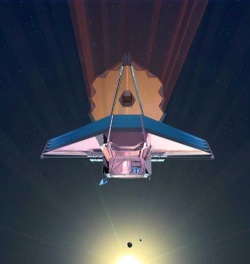
NASA Goddard Space Flight Center, Greenbelt, Md., is building the James Webb space telescope, whose unique beryllium mirror system will enable it to examine the earliest times of the universe when launched in 2018. The primary mirror is about 21 feet across, and is composed of 18 segments. Each segment is made of reflective gold-coated beryllium supported by a beryllium frame.
The beryllium mirror substrate is the part of each mirror segment that acts as a mirror. Each substrate is nearly two inches thick with a highly-polished and exquisitely smooth “front” reflective side and a “back” side that is precision machined into a sort of egg crate-looking structure to make it lighter weight than it would be if solid. The reflective surface is polished to an “average” roughness of only 20 nanometers (i.e., 20 billionths of a meter) and coated with a microscopically thin layer of pure gold to maximize its ability to reflect infrared light. Beryllium is the material of choice because is it extremely stiff and lightweight, and it behaves very stably and predictably at Webb’s extremely cold operating temperatures.
The mirrors were built by Ball Aerospace & Technologies Corp., Boulder, Colo. Ball is the principal subcontractor to Northrop Grumman for the optical technology and lightweight mirror system. Ball Aerospace also developed the secondary mirror, tertiary mirror and fine-steering mirror.
“The complexity of the mirror assemblies comes from the fact that they are designed to be very lightweight, work at cryogenic temperatures below -400°F, survive launch vibration and forces, be align-able on-orbit via actuators, and then stay aligned for up to two weeks as though they are a single large mirror,” said Lee Feinberg, NASA Optical Telescope Element Manager for the James Webb Space Telescope at the Goddard Space Flight Center.
For much more information, visit
http://nasasearch.nasa.gov/search?utf8=%E2%9C%93&affiliate=nasa&query=webb+space+telescope