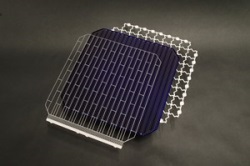
GT Advanced Technologies Inc., Merrimack, N.J., announces that solar modules incorporating its new Merlin metallization and interconnect technology have met the requirements of several PV industry certification standards. With Merlin technology, segmented silver fingers are printed onto the cell, and a flexible plated copper grid is attached to the segmented fingers on top of the solar cell, replacing the three traditional silver busbars and cutting panel weight by almost 50%.
A key component of Merlin is the flexible grid that replaces the three silver bus bars. The novel attributes of the technology are expected to significantly reduce the amount of expensive silver paste while improving panel efficiency. The resulting modules are expected to be more reliable and durable and enable form factors that are lighter and easier to handle, resulting in lower shipment and installation costs.
The certification testing was performed by RETC (Renewable Energy Test Center), an independent certification testing provider. Conformance to the certification standards was verified by the Canadian Standards Association and TUV-Sud. The results confirm that cells and modules incorporating Merlin’s novel approach to metallization and module interconnect meet the performance, safety, and quality requirements outlined by the IEC 61215, 61730-1, -2 and UL1703 tests. The tests are designed to determine long-term reliability of silicon-based modules.
“Meeting these industry standard reliability criteria is an important milestone as we move toward commercial availability of our Merlin metallization and interconnect technology,” said Venkatesan Murali, senior vice president and general manager of advanced systems development at GT. “Going forward, we plan to continue reliability testing these modules to failure to validate that the Merlin-based modules are substantially more robust by design than what is required.”