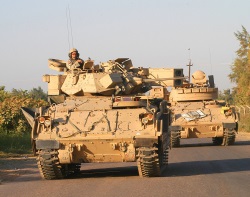
Aleris, Cleveland, Ohio, announces that it now offers a new 7017 aluminum alloy in North America for commercial plate and defense applications. After extensive review and testing of Aleris 7017, the United States Army Research Lab (ARL) issued MIL-DTL-32505 for armor applications. The weld compatibility of the new alloy gives great flexibility to armored vehicle designers, enabling them to incorporate different design characteristics.
The optimum balance of elements that comprise Aleris 7017 provides for superior stress-corrosion cracking resistance while maintaining high strength and weldability properties.
“7017 has a unique combination of properties, making it ideal for the most advanced armor solutions,” said Lawrence Kramer, global defense field engineer at Aleris. “These include high strength, weldability, and corrosion resistance. This alloy is currently utilized in Europe and Asia on combat vehicles to achieve superior ballistic protection.”
To develop a new alloy for America’s ground forces, ARL engineers place the product through a series of standardized tests to validate the material’s performance in the ballistic protection level, corrosion resistance, and weldability.
“The analysis has resulted in a significant protective benefit as Aluminum Alloy 7017 has demonstrated a reduction in spallation compared with the legacy AA7039,” says Tyrone Jones, mechanical engineer in the Armor Mechanisms Branch. “An armor plate must not only arrest the projectile, but mitigate the kinetic energy before it fatally compromises a protected asset.”
Fusion welds of 7017 plate have excellent strength with the weld heat-affected zone strengthening with time. 7017 is weld compatible with the 5xxx series alloys such as 5083 and Alustar 5059, Aleris’ high-strength alloy designed to withstand corrosive environments.