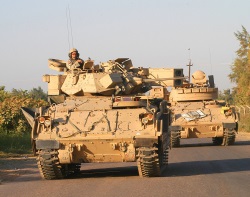
Alcoa, Pittsburgh, has produced the world’s largest single-piece forged aluminum hull for combat vehicles to improve troop protection as part of a joint Alcoa-U.S. Army initiative launched last year. Alcoa manufactured the single-piece part, which was co-designed by Alcoa and the U.S. Army Research Laboratory, with the goal of replacing today’s assembled hulls.
Forging hulls as one unit facilitates three-dimensional shaping, allowing Alcoa to tailor the thickness where needed to maximize protection and allow for weight savings. A monolithic hull could be used to produce new, or retrofit existing combat and tactical vehicles.
Alcoa produced two demonstrator forgings at its plant in Cleveland using its 50,000-ton forging press, the world’s most advanced hydraulic press. Alcoa’s engineers in Cleveland leveraged their expertise and decades of commercial forging experience to produce the hull earlier than the expected deliverable of 18 months.
Based on early modeling and simulation, single-piece underbody structures could provide two times better protection against blasts than traditional hulls, primarily by eliminating welded seams. In addition to survivability benefits, single-piece hulls can be optimized to reduce vehicle weight and assembly time, and, therefore, overall cost.
The Army is now blast testing the hull to demonstrate its durability. After successful testing, this initiative would open up numerous opportunities for the military to apply single-piece structures to large combat vehicles and other applications.
Alcoa produced two demonstrator forgings at its plant in Cleveland using its 50,000-ton forging press, the world’s most advanced hydraulic press. Alcoa’s engineers in Cleveland leveraged their expertise and decades of commercial forging experience to produce the hull earlier than the expected deliverable of 18 months.