A research team by the National University of Singapore (NUS) developed Cloud Arch, an innovative, ultra-light architecture that will revolutionize the way large open public spaces, such as markets, airports, stadiums, concert halls, and factories are built. Cloud Arch harnesses ultra-light materials to meet the construction needs of sustainable future. The patent-pending technology is jointly developed by a research team led by Shinya Okuda, assistant professor, School of Design and Environment, and Tan Kiang Hwee, professor, Faculty of Engineering, in collaboration with structural engineering consultancy firm Web Structures.
“We decided to use expanded polystyrene (EPS) foam, a widely used packaging material. More than 95% of this material is air, and its composite can be fire-resistant. After two years of prototyping and structural testing, we successfully developed a technique to control the composite material and applied it for the construction of long-span structures,” says Okuda. “We also developed several prototypes—starting from a mere 4 meter span, to the current design comprising two sets of 14 meter span in the form of the pavilion. As the design looks like a floating cloud, we called it Cloud Arch,” he adds.
“Structurally optimized forms are often doubly curved. By applying digital fabrication technology on the EPS foam, we could shape complex forms in a fast and cost-efficient manner. As the material is extremely lightweight, we could achieve significant savings in terms transportation cost as well as the time taken to set up and dismantle the structures. With Cloud Arch, we hope to reduce the construction cost by one-third and construction time by half, compared to conventional construction materials, such as concrete,” says Okuda.
Hwee adds, “EPS foam has almost similar compression strength to weight ratio as concrete and is currently used as landfill for landscape works. We are also testing its composite properties when reinforced with bonded fabric as a possible material for permanent construction.”
The next step is to develop a 24-meter span factory roofing prototype. This project is supported by the NUS-JTC Industrial Infrastructure Innovation (I3) Centre, which was set up jointly by NUS and JTC Corporation in 2011 to promote the development of innovative and sustainable industrial infrastructure solutions in Singapore. Other possible applications of the technology include developing longer spans for airplane hangars.
“20th century visionary R. Buckminster Fuller once envisioned his invention Geodesic dome to cover 3km radius over the Manhattan in the 1960’s for the energy efficient built environment. We hope that the Cloud Arch could make such a great impact on the sustainable built environment in the 21st Century,” concludes Okuda.
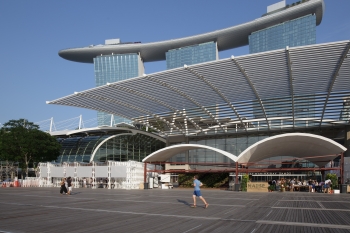
Image caption — Cloud Arch on display at Marina Bay Sands.