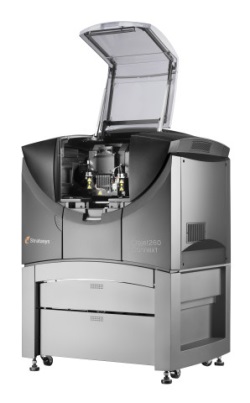
Stratasys, Minneapolis, announces that triple-jetting technology is now available cross-platform, providing up to 20% faster fused-deposition-modeling production. Material combinations include flexible, rigid, and color materials in a single part, from compact, office-compatible 3D printers, to industrial-scale systems. For the first time, customers can create 3D tools for food processing and carry out steam-sterilization of medical devices.
Aerospace and automotive customers can benefit from enhanced speed, toughness and chemical resistance, with the new advanced ULTEM 1010 FDM material capabilities. Designed specifically with manufacturers in mind, ULTEM 1010 combines superior heat resistance, tensile strength and chemical resistance, and can be sterilized using steam autoclaving for medical applications. It is also bio-compatible and has the only food-contact certification of any FDM thermoplastic. These properties make the ULTEM 1010 the right choice for aerospace, automotive, food production tooling, and medical device manufacturing and functional prototyping applications.
The Objet260 Connex 1, 2, and 3 series is a compact and office friendly platform, while the Objet350 Connex 1, 2, and 3 series deliver the same capabilities with larger build sizes. To increase productivity, all six 3D printers provide triple-jetting workflow advantages like hot-swap and fewer material changeovers. Further enhancing ease of use and workflow, the Objet260 and Objet350 Connex3 3D Printers (and the existing Objet500 Connex3) will support VRML-exported CAD files in addition to the traditional STL, and deliver color, multi-material 3D printing.