Nanomaterials have been used in a variety of emerging applications, such as in targeted pharmaceuticals or to bolster other materials and products such as sensors and energy harvesting and storage devices. A team in the McKelvey School of Engineering at Washington University in St. Louis is using nanoparticles as heaters to manipulate the electrical activity of neurons in the brain and of cardiomyocytes in the heart.
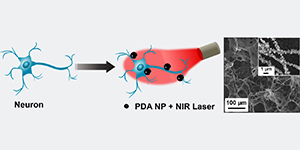
Srikanth Singamaneni, a materials scientist, and Barani Raman, a biomedical engineer, and their teams collaborated to develop a noninvasive technology that inhibits the electrical activity of neurons using polydopamine (PDA) nanoparticles and near-infrared light. The negatively charged PDA nanoparticles, which selectively bind to neurons, absorb near-infrared light that creates heat, which is then transferred to the neurons, inhibiting their electrical activity.
In addition to their ability to efficiently convert light into heat, the PDA nanoparticles are highly biocompatible and biodegradable. The nanoparticles eventually degrade, making them a convenient tool for use in in vitro and in vivo experiments in the future. The team has designed a photothermal foam that is similar to a sugar cube, forming a dense population of nanoparticles in tight packaging that acts more quickly than individual sugar crystals that disperse.
In addition, the team, which includes Jon Silva, associate professor of biomedical engineering, applied the PDA nanoparticles to cardiomyocytes, or heart muscle cells. Interestingly, the photothermal process excited the cardiomyocytes, showing that the process can increase or decrease the excitability in cells depending on their type.
Now, the team is looking at how different types of neurons respond to the stimulation process. They will be targeting particular neurons by selectively binding the nanoparticles to provide more selective control.
For more information: School of Engineering at Washington University in St. Louis