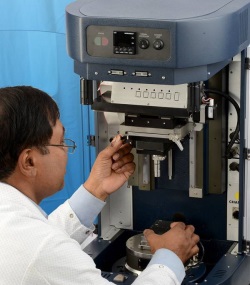
Bruker, Tucson, Ariz., has release the UMT TriboLab, the latest generation of the Universal Mechanical Tester (UMT) platform. TriboLab incorporates into a single, modular platform the full range of performance previously offered in several UMT models. It provides increased load capacity and higher torques, all with greater ease of use and less training required.
As with previous UMT models, the UMT TriboLab has a universal base that can be equipped with a range of drive modules to allow multiple, different tribology tests to be performed on one platform. The design of the new TriboLab emphasizes ease-of-use due to a tool-less drive exchange, and easier software and scripting capabilities. It offers higher performance in areas such as speed, torque, and data accuracy. The redesign of the product also offers enhanced modularity while simplifying configuration requirements.
Its TriboID feature automatically recognizes the attached modules, and reconfigures user menus based on the hardware installed. The system’s new TriboScript software is controlled entirely through a user-friendly graphical interface, enabling even complex scripts to be created simply by dragging and dropping icons. The launch of the UMT TriboLab system also introduces a new line of dual-axis, Gold-Series force sensors with an ultralow noise floor and optional increased frequency response.
Michael Khonsari, the Dow Chemical Endowed Chair and Professor and Director of the Center for Rotating Machinery (CeRoM) at the Department of Mechanical Engineering at Louisiana State University in Baton Rouge, Louisiana, added: “It is exciting to see a new generation of Bruker UMT coming to the market as we have several of its predecessors in our Center, and rely on them heavily. We are actively involved in collaborative projects with industry partners. Having the Bruker UMT in our Center enables us to perform various tribological tests precisely and efficiently, giving us confidence in reporting our results in archival journals.”