Researchers from the Centre for Biomedical Technology of Universidad Politécnica de Madrid (UPM) and the Institute of Materials Science and the Institute of Catalysis and Petrochemistry of Consejo Superior de Investigaciones Científicas (CSIC), in collaboration with the Mahou and Createch Co., all in Spain, developed biocompatible materials to be used as support for bone regeneration from the food industry waste, mainly bagasse (residue) from beer brewing.
These new materials can be considered as an alternative to the prosthesis made from processed sheep bones or synthetic materials which are more expensive and more harmful to the environment. Waste from the beer brewing process contains the main chemical components found in bones (phosphorus, calcium, magnesium, and silica), that after undergoing modification processes, can be used as support or scaffold to promote bone regeneration for medical applications such as coating prosthesis or bone grafts. Waste usage from the food industry is a great source of raw material recovery rich in chemical diversity, and simultaneously it can reduce the impact generated by the accumulation of waste in the environment
So far, use of synthetic materials as bone substitutes is the most used therapy for treatment of bone diseases. Therapeutic strategies are based on stiff porous scaffolds made of biocompatible materials to be used as molds. These molds will provide mechanical stability and will promote the growth of the new bone tissue that helps its regeneration.
Synthetic calcium phosphates are frequently used as matrices and coatings for orthopedic implants because of their resemblance to the composition of a bone. These materials are often obtained through chemical reactions of complex synthesis that use toxic reagents (for example benzoyl peroxides benzene and aniline) and calcinations at high temperatures close to 1500°C. As a result, bioceramics are obtained just after adding silicon through the hydrolysis of TEOS and sintering over 1100°C.
Bagasse is constituted by organic waste from malt, never experiencing modifications afterwards. This is the reason why bagasse is considered a subproduct, commonly used to make fodder and is inexpensive. The treatments applied to bagasse residue results in a new material rich in silicon, phosphorus, calcium, and magnesium. Analysis shows the presence of interconnected pores of between 50 and 500 μm in diameter—similar to the porosity of cancellous bone. All this would facilitate the complete vascularization after a bone implant.
Using cell cultures, the biocompatibility of the materials was established by analyzing the cell viability of cultured osteoblasts in the presence of powder materials components. After compacting and sintering the materials that became 3D solid matrixes, the ability of bone-like cells to adhere to these materials was then analyzed. Researchers also analyzed how these materials proliferate and distinguish from mature bone cells which are able to express typical markers of bone phenotype such as alkaline phosphatase and to conduct the collagen synthesis and mineralization of the extracellular matrix.
This research, developed by UPM and CSIC in collaboration with the Mahou and Cratech Co. within the framework of the INPACTO project funded by MINECO, reveals the value of these materials derived from the food industry for their conversion into support or scaffolds suitable for bone regeneration.
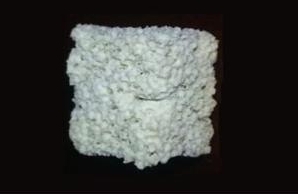
Image caption – A biomaterial used as a matrix for bone regeneration was made from the beer bagasse treatment. Courtesy of Angeles Martín Luengo, Malcom Yates, and Eduardo Sáelz./CMM-CSIC and IPC-CSIC.