Several key steps are required to produce optimized thermal spray coatings prior to processing, during processing, after processing, and during coating design.
To ensure adequate bonding of a coating, it is critical that the substrate be properly prepared. The substrate surface must be clean and usually must be roughened after cleaning by grit blasting or some other means. Masking and preheating of the substrate are most commonly carried out prior to the application of thermal spray coatings as well as other precoating operations.
Coating quality also depends on spray process variables and parameters such as part temperature control, gun and substrate motion, spray pattern, and deposition efficiency and deposit rate.
Postcoating operations further enhance the quality of thermal spray coatings. These operations include finishing treatments such as grinding and polishing, densification treatments such as fusion, hot isostatic pressing, and heat treating, sealing, and testing and inspection.
In addition to these processing steps and parameters, it is important to understand how to design coatings for optimal performance. Thermal spray coatings are fabricated by combining equipment (spray guns, process controls, manipulators, etc.), feedstock materials (powders, wires, or rods), and engineering and process know-how (experience). Only when all components of the spray process are used correctly does a well-designed coating result.
This information is from ASM Handbooks Online, Vol. 5A: Thermal Spray Technology, Coating Structures, Properties, and Materials. To find this information (subscription required), click on the link below and scroll down to Figure 1.
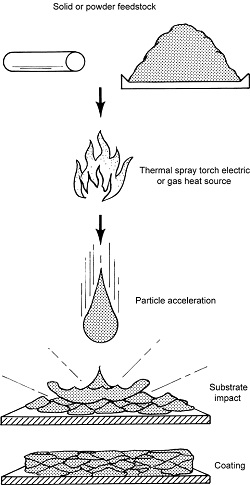
Image – Schematic of the thermal spray process.