Researchers at the Georgia Institute of Technology, Atlanta, produced a color-changing glass that creates electrical charges enough to power a smartphone. The team developed several types of smart glass by subjecting materials to rain and wind. Their objective was to find a way to coat windows to facilitate triboelectrics, the process of harnessing energy in static electricity that happens when two materials met.
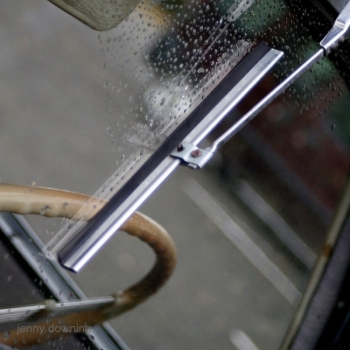
Two layers of solution were needed to achieve the desired effect: one layer was used to harness the energy found in raindrops while the other layer was to do the same for wind. Researchers created nanosized generators for the first layer that would utilize the positive charge in raindrops. This occurs when the water droplets rub against air as they fall to the earth and make contact with the windshield of a car.
The second layer involved sandwiching two charged plastic sheets with small springs. As the car accelerates, the wind pressure builds up pushing the sheets against each other. This action then produces the electric current needed for the experiment. By combining the two layers together, the researchers were able to create a type of glass that is initially clear but then becomes blue in tint.
The process also produced around 130 mW of electricity per square meter of the glass, enough to power the battery of a smartphone. According to the results, the new smart-glass system is beneficial to wireless networks as it provides an external source of power for independent and sustainable operations. The experiment also led to the invention of the triboelectric nanogenerator (TENG) that allows ambient mechanical energies to be converted into electricity which could then be used to charge mobile devices.
The smart window system the researchers developed was integrated with the electrochromic device (ECD) of a TENG. The device collects the electrical charges generated by wind and raindrops.
Image caption—A new type of color-changing glass harnesses static charges from wind and raindrop and might generated enough electricity to power a mobile device. Courtesy of Jenny Downing/Flickr.