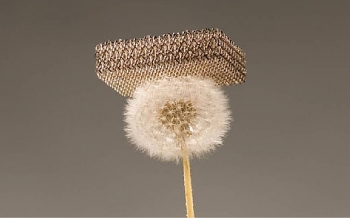
The Boeing Co., Seattle, released a video showcasing the lightest metal structure ever, called Microlattice—”the world’s lightest material.”
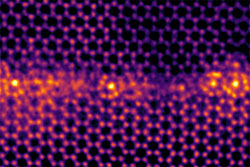
Sophia Yang, a research scientist at HRL Laboratories, Malibu, Calif., who worked with Boeing on the creation of the material, says the metal is 99.99% air. She compares the material to bone, which has a rigid outside and mostly hollow inside, creating an open-cellular structure, which means it’s remarkably strong and light. The structure is composed of a network of super thin, hollow struts. The struts are around 100 μm in diameter and have walls just 100 nm thick. It’s this design that makes Microlattice 10 times lighter than Styrofoam. However, despite it being extremely light, it is also tremendously strong.
Yang also highlights the material’s ability to absorb high levels of impact. Using the “egg challenge” as an example, she says: “You need to drop an egg from 25 stories and protect that egg … What we can do is design the microlattice to absorb the force that the egg feels. So instead of having an egg that’s wrapped in three feet of bubble wrap, now you have a much smaller package that your egg can sit in.”
The material has been made primarily for use in in aerospace engineering. Engineers intend to use the microlattice for plane interiors in places such as side panels, overhead cabins, or walkway areas. This would dramatically reduce the weight of the aircraft, making it more fuel-efficient and cheaper to run.
Microlattice was first announced in 2011 when a nickel-phosphorous alloy prototype was developed in collaboration between University of California, Caltech, and HRL Laboratories—the Boeing-owned lab that built the first laser in 1960. As the video explains, this development has many possibilities, ranging from use in aerospace, high-performance vehicles, as well as shock absorption and vibration insulation.