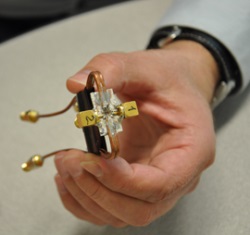
Engineers at Ohio State University, Columbus, report that they have developed vaporized foil actuator (VFA) welding, a technique that consumes 80% less energy than conventional techniques, yet produces bonds that are 50% stronger. In VFA, a high-voltage capacitor bank creates a very short electrical pulse inside a thin piece of aluminum foil. Within microseconds, the foil vaporizes, and a burst of hot gas pushes two pieces of metal together at speeds approaching thousands of miles per hour.
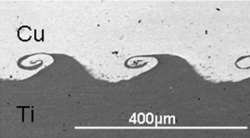
The pieces don’t melt, preventing the formation of a seam of weakened metal between them. Instead, the impact directly bonds the atoms of one metal to atoms of the other. Seen under a high-powered microscope, the bond often features delicate curlicues in spots where veins of both materials extend outward and wrap around each other.
The technique needs less energy because the electrical pulse is so short, and because the energy required to vaporize the foil is less than that required to melt the metal parts.
So far, the engineers have successfully bonded different combinations of copper, aluminum, magnesium, iron, nickel, and titanium. They have created strong bonds between commercial steel and aluminum alloys–a feat which is impossible normally. Also, high-strength steel and aluminum join together with weld regions that are stronger than the base metals.
Glenn Daehn, a Fellow of ASM and professor of materials science and engineering at Ohio State, who helped develop the new technique, explained the new process in a keynote address at the ASM Materials Science & Technology 2015 meeting recently in Columbus.