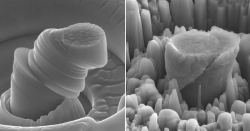
University of California at Los Angeles researchers have reportedly designed a magnesium-matrix composite reinforced with a dense and even dispersal of silicon carbide nanoparticles. Infusing about 14% silicon carbide nanoparticles (<100 nm) into a molten magnesium-zinc alloy added significant strength, stiffness, plasticity, and durability at high temperatures.
To create the composite, the team found a new way to disperse and stabilize nanoparticles in molten metals. They also developed a scalable manufacturing method that could pave the way for more high-performance lightweight metals. Potential applications include aerospace, cars, electronics, and biomedical devices.
“It’s been proposed that nanoparticles could really enhance the strength of metals without damaging their plasticity, especially light metals like magnesium, but no one has been able to disperse ceramic nanoparticles in molten metals until now,” said Prof. Xiaochun Li, the principal investigator on the research and Raytheon Chair in Manufacturing Engineering at UCLA. “With an infusion of physics and materials processing, our method paves a new way to enhance the performance of many different kinds of metals by evenly infusing dense nanoparticles.”
Ceramic particles have long been considered as a potential way to make metals stronger. However, with microscale ceramic particles, the infusion process results in a loss of plasticity.
Nanoscale particles, by contrast, can enhance strength while maintaining or even improving plasticity. But nanoscale ceramic particles tend to clump together rather than dispersing evenly, due to the tendency of small particles to attract one other.
To counteract this issue, researchers dispersed the particles into a molten magnesium -zinc alloy. The nanoparticle dispersion relies on the kinetic energy in the particles’ movement. This stabilizes the dispersion and prevents clumping. To further enhance the composite’s strength, the researchers used a technique called high-pressure torsion to compress it.