Pacific Northwest National Laboratory, Richland, Wash., announces that its research team has improved the strength of a titanium alloy by producing it via powder metallurgy and heat treating it at different temperatures, then quenching in cold water.
Five decades ago, metallurgists created an alloy named Ti185 by blending titanium with low-cost iron, aluminum, and vanadium. However, superior strength was observed for this alloy only in some places, and the alloy had a tendency to clump. Iron clustered in some areas, leading to beta fleck defects, making the alloy unsuitable for reliable commercial production.
Subsequently, in a study carried out about six years ago, the PNNL researchers and its collaborators devised a low-cost powder metallurgy process for the industrial-scale production of the alloy. They used titanium hydride powder instead of molten titanium as the starting material, reducing the energy requirements significantly and cutting the process time in half. ADMA co-developed the method with PNNL metallurgist Curt Lavender. The company sells advanced materials such as the titanium hydride powder to industries, including aerospace.
In their earlier study, the researchers had already demonstrated the superior mechanical properties of the titanium alloy created from their low-cost process. In the new study, they explored how to make even stronger titanium alloys. The team was able to gain insights into the nanostructure of the alloy by using a unique atom probe imaging approach and powerful electron microscopes.
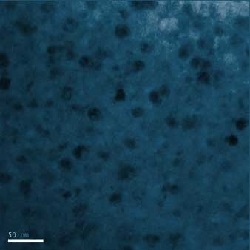
Using electron microscopy, the team observed the microstructure of the alloy at a resolution of hundreds of nanometers. The atom probe tomography system at the Environmental Molecular Sciences Laboratory, a DOE Office of Science User Facility located at PNNL, was used to observe the arrangement of individual atoms in 3D.
The researchers found that their optimized heat-treating process produced an alloy with an alpha phase, consisting of micron and nanometer -size precipitate regions, in a matrix of beta phase. Each region has higher concentrations of certain elements. The aluminum and titanium atoms are found inside the nano-sized alpha phase precipitates, whereas vanadium and iron are in the beta phase.
“We found that if you heat treat it first at a higher temperature before a low -temperature heat treatment step, you could create a titanium alloy 10 to 15% stronger than any commercial titanium alloy currently on the market, and that it has roughly double the strength of steel,” says Arun Devaraj, Materials Scientist at PNNL
“This alloy is still more expensive than steel, but with its strength-to-cost ratio, it becomes much more affordable with greater potential for lightweight automotive applications,” added Vineet Joshi, who serves as a metallurgist at PNNL.