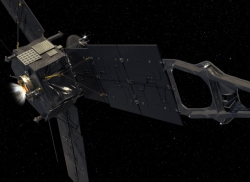
Developed by Lockheed Martin, Sunnyvale, Calif., the Juno spacecraft is hexagonal in shape, is 3.5 meters tall and 3.5 meters in diameter, and has a liftoff mass of about 8000 pounds. It carries a suite of nine instruments capable of observations from radio and microwave through infrared, visible, and ultraviolet frequencies, in addition to particle sensors and magnetometers. To protect the sensitive spacecraft electronics, Juno has a unique titanium vault with walls one centimeter thick, mounted between the spacecraft main structure and its high gain antenna.
The vault acts as shielding to protect the critical spacecraft computers and instrument computers from the high energy particles it encounters when the orbit comes close to the planet. Juno is also the first planetary spacecraft to fly 3D-printed parts. A dozen 3D-printed wave guide brackets are made of a titanium alloy.
Juno is the first solar-powered spacecraft to operate at Jupiter, and it also holds the record as the farthest spacecraft from the sun to operate on solar power.
To power the computer, instruments, and heaters, Juno has three 30-foot-long solar arrays with a combined 18,698 individual solar cells covering an area of 535 square feet. On Earth, the arrays would be capable of generating over 14 kilowatts, yet will provide only about 500 watts at Jupiter.
The spacecraft is designed for one-year science operations with 33 elliptical orbits, and it will purposely de-orbit into Jupiter in early 2018 to protect Jupiter’s moons from any spacecraft debris that could impact them.
http://spaceflight101.com/juno/spacecraft-information/