Bruker Nanoanalytics, Germany, introduces the e-FlashFS and e-FlashHD, two models of a new generation of detectors for electron backscatter diffraction analysis on scanning electron microscopes; and Esprit Qube, a new software package for advanced post-processing and visualization of 3D EBSD/EDS data cubes.
With the fast and sensitive e-FlashFS and the high-definition e-FlashHD, Bruker now offers two complementary detectors to optimally cover all EBSD applications, from everyday characterization of minerals and alloys, to advanced analysis of nano- and functional materials.
Due to an increase in sensitivity by a factor of three compared to its predecessor e-Flash1000, the new e-FlashFS will significantly expand the range of application fields where high-speed EBSD can be used. The combination of improved sensitivity and high speed makes the e-FlashFS the EBSD detector of choice for low-kV applications, as well as for dynamic experiments such as in-situ heating or tensile testing.
When equipped with the unique Optimus detector head for transmission Kikuchi diffraction (TKD), the e-FlashFS provides orientation maps with spatial resolution as good as 2 nm and high contrast dark field/ bright field images with resolution of 1 nm or better, all within minutes or even seconds. This speed enables applications in many areas such as the semiconductor industry, applications that were only accessible by transmission electron microscopy (TEM) until now.
The new e-FlashHD detector features a CCD camera resolution of 1600×1200 pixels and state-of-the-art camera optics for minimized image distortions, enabling high definition Kikuchi patterns that display the finest details. Due to improvements to the cooling system, the CCD’s dark current is reduced by a factor of four compared to the previous generation e-FlashHR, resulting in significantly enhanced signal-to-noise ratios and thus even better pattern quality. These advancements make the e-FlashHD a very powerful tool for residual strain analysis, ultra-accurate phase identification, or the analysis of pseudo-symmetry in crystalline structures.
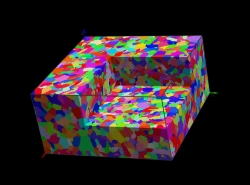
The new Esprit Qube software provides extensive and powerful tools for 3D visualization and post-processing of data sets acquired with EBSD and/or energy-dispersive X-ray spectrometers (EDS). Whether 3D data sets are generated automatically in dedicated FIB/SEM instruments, or by conventional metallography techniques and standard SEM, Esprit Qube enables true 3D data representation and analysis.