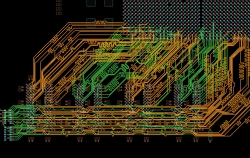
Mentor Graphics Corp., Wilsonville, Ore., announces the first phase of the new Xpedition printed circuit design flow to address the increasing complexity of today’s advanced systems. The increasing densities of electronics products are forcing companies to develop highly compact system designs with more functionality, and at lower cost. To efficiently manage the density and performance requirements, the new Xpedition flow provides advanced technologies to enable design and verification of 3D rigid-flex structures, and to automate layout of high-speed topologies with advanced constraints.
Engineers can design complex rigid and flex PCBs in a fully supported 3D environment (3D design and verification—not just a 3D view), resulting in a correct-by-construction methodology for optimum reliability and product quality. 3D verification ensures that bends are in the right position, and elements on the board do not interfere with folding; this can be reviewed early in the design stage to prevent costly redesigns. Users can then export a 3D solid model to MCAD for efficient bi-directional PCB-enclosure co-design.
Integration with Mentor’s leading HyperLynx high-speed analysis technology enables optimization of signal and power integrity across complex rigid-flex stack-up structures. For fabrication preparation, the Xpedition flow provides all flex and rigid information using the ODB++ common data format. This methodology eliminates data ambiguities by clearly communicating the finished board intent to the fabricator. The new Xpedition flow is the optimum solution designed specifically for flex and rigid-flex design, from conception through fabrication output.”
“Mentor’s new Xpedition flow provides multiple board outlines, stack-ups, and bend areas which allow us to define a rigid flex within the design environment, and export a folded 3D step model for efficient mechanical design integration,” stated Charles Ietswaard, PCB design engineer at NIKHEF, the national institute for sub-atomic physics in The Netherlands. “The automated rigid-flex capabilities in Xpedition help us manage the growing complexities of today’s advanced PCB systems with ease, higher productivity and overall product reliability.”