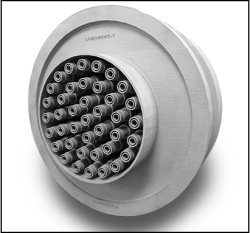
Marshall Space Flight Center, Huntsville, Ala., reports that Stratasys Direct Manufacturing, Minneapolis, helped build a rocket injector 15 times faster than traditional manufacturing with direct metal laser sintering. The part was manufactured of Inconel 625 in about 300 hours in an EOS M280 machine with proprietary build parameters. The technology enabled consolidating the traditionally manufactured 163-component part into a two-piece unit. This ability to rapidly create highly complex parts makes it attractive to the aerospace industry.
Traditional manufacturing requires holes drilled into each element of the injector inlet. Then, a fitting is machined with unique flow features and welded to the first element. The process requires multiple pieces to be welded, machined, cast, and otherwise bonded together to build the injector.
Conversely, the DMLS-built injectors allowed the intricate, unique swirl pattern to be built directly into the inlet of the injector in one print. The 3D printed injectors successfully passed hot fire, static, and strenuous mechanical property tests – all of which are critical stages in the validation process.
Typically, Marshall uses powder bed metal fusion (e.g. DMLS, electron beam melting, and selective heat sintering) for all its 3D printing, and the center also prints with direct powder injection. The latter form of manufacturing injects metal powder into a laser beam as the part is fabricated, and enables building larger parts.
https://www.stratasysdirect.com/case-studies/nasa-sls-propulsion-program/