NIST, Gaithersburg, Md., has released a new, expanded edition of the NIST Recommended Practice Guide, “Fractography of Ceramics and Glasses” (NIST Special Publication 960-16e2), a guide developed to help engineers and scientists analyze the patterns in fractures of ceramics and glasses.
Since it was first published in 2007, “Fractography of Ceramics and Glasses” has been used in training courses and by members of industry for failure analysis, helping to improve production methods and product quality.
The new edition of the guide, which is 15% larger than its predecessor, includes 300 new illustrations and covers the state of the art in fractography, including descriptions of new documentary standards. The guide, with nearly 1000 images, covers various topics including equipment (with updates on new microscopy techniques), patterns in glass and ceramic fractures (the “fingerprints” that make failure analysis possible), an expanded chapter on quantitative analysis of fractures, and composites—including new materials used in dentistry. Actual case studies help readers see how the guide is used in practice.
Mechanical engineer George Quinn, the author of both the original and expanded editions, joined NIST in 1990 to perform strength testing on ceramic materials. In collaboration with ASTM, an international standards organization, Quinn helped to develop two world-first ceramic strength tests. Since formally retiring from NIST in 2009, Quinn has continued to serve the organization as a research associate.
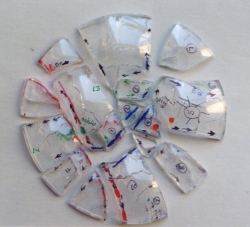
The photo shows a fractured sapphire dome.
The guide may be accessed online. Hard copies are available upon request(link sends e-mail).