Materials scientists at the Christian-Albrecht University of Kiel (CAU) in Kiel, Germany, synthesize nanoscale gradient copolymers with contradictory properties for the first time. They use principles inspired by material properties found in nature to develop unique ultra-thin copolymer films with gradually varying properties.
As multifunctional coatings, these gradient thin films could enable completely new applications in miniature format in complex optics, microelectronics, sensors, and biomedicine, for example gradual anti-reflective lenses. Their results were recently published in and featured on the cover of the Materials Today journal.
In nature, materials with simultaneously contrasting properties are common, for example, in mussels. In order for soft tissues inside mussel shells to dock stably to a hard surface like a stone, its soft elastic adhesive threads become continuously harder towards one end of its shell. This gradual transition occurs because the mixture of proteins changes evenly from one end to the other within the fiber.
Stefan Schröder, Ph.D. at the Chair for Multicomponent Materials at CAU, combined two materials with different properties at the nano level as a way to synthesize such gradients as ultra-thin polymer films for the first time. He and his colleagues combined polytetrafluoroethylene (PTFE, or Teflon) with the polymer PV3D3, taking advantage of their contrasting non-stick and adhesive properties.
By gradually combining the two materials at the nano level, the research team was able to join them in a smooth transition, retaining properties of each at either ends. The result is a coating material with a water-repellent upper side and a well adhering lower side.
Coating surfaces with polymers in a controlled manner cannot simply be vaporized or sputtered without decomposition. The initiated chemical vapor deposition (iCVD) technique developed at the Massachusetts Institute of Technology was used not only to create thin polymer layers but also to simultaneously bond two polymers in a gradual transition.
After introducing the V3D3 monomer, they added the starting material for the PTFE deposition and continuously increased its concentration. At the same time, they lowered that of V3D3, so that both form a polymer film on the substrate with a gradual transition from a pure PV3D3 polymer to a pure PTFE film starting from the substrate surface.
Equipping a conventional iCVD system with an open ion source quadrupole mass spectrometer allowed in situ observation of the processes in the reaction chamber to adjust the composition of the gas mixture of the initiator and the two monomers at the same time.
Due to this high-precision control, the research team synthesized a polymer gradient layer twenty one nanometers thick. Previously, only macroscopic gradients had been possible.
******
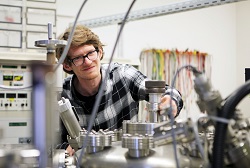
Image – As part of his PhD thesis, materials scientist Stefan Schröder developed a method for producing nano-thin gradient copolymer films that combine different properties. Courtesy of J. Siekmann / Uni Kiel.
For more information:
University of Kiel
https://www.uni-kiel.de/de/