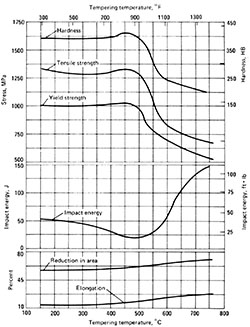
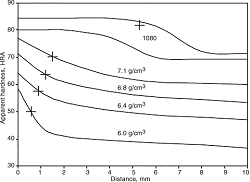
This graph shows AISI Type 410: Effect of tempering temperature on tensile properties. Heated to and held at 1800°F for 30 minutes; oil quenched; tempered 1 to 4 hours. Impact energy test used Izod specimens. Elongation was measured in 2 in.; yield at 0.2% offset.
The nickel-bearing alloys have a restricted upper tempering temperature because of the danger of re-forming austenite, which would then transform to untempered martensite during cooling, requiring a second tempering operation. Intermediate temperatures can lead to temper embrittlement, which is caused by the precipitation of phosphorus and other species, including but not limited to carbides, at prior austenitic grain boundaries. Temper embrittlement is distinct from the precipitation of α’, which causes the well-known 890°F embrittlement, which occurs more severely in alloys with higher chromium levels.
Volume 4D, Heat Treating of Irons and Steels ⇒ Heat Treated High-Alloy Steels ⇒ Heat Treating of Martensitic Stainless Steels ⇒ Tempering