Porosity has the greatest single effect on the response of PM Steels to heat treatment compared with conventional steels. The majority of parts have a porosity between 5 and 15 vol%, far more than is found in a typical casting. Every mechanism in press and sinter is subject to diminishing returns; i.e., compact density has a decreasing dependence on compaction pressure, as does sintering and homogenization.
It is possible to achieve very high densities in PM steel materials, but the increased difficulty, and hence cost, combined with lower-dimensional control means that few PM steels are made to be fully dense. Porosity influences heat treatment through its effect on density, thermal conductivity, proof testing particularly hardness, permeability to gases and liquids, Electrical resistivity in induction hardening.
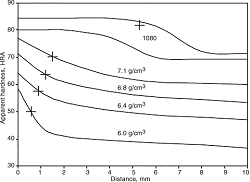
The effect of porosity on the hardenability of PM steel is shown in the figure, where results of a series of Jominy tests on sintered carbon-steel test pieces are compared with those for wrought steel. Specimens were prepared from iron powder mixed with 0.95 graphite, pressed, and sintered to densities ranging from 6.0 to 7.1 g/cm3 (0.217 to 0.256 lb/in.3). These correspond to porosity levels ranging from 9 to 24%. Jominy end-quench tests were performed on PM test specimens and the wrought C1080 steel specimen austenitized at 870°C (1600°F) for 30 min in a protective neutral atmosphere.
For more information, click on the link below (subscription required). Then scroll to Figure 5.
Joseph W. Newkirk, Heat Treatment of Powder Metallurgy Steels, Heat Treating of Irons and Steels, Vol 4D, ASM Handbook, Edited By Jon L. Dossett, George E. Totten, ASM International, 2014, p 253-273, https://doi.org/10.31399/asm.hb.v04d.9781627081689.