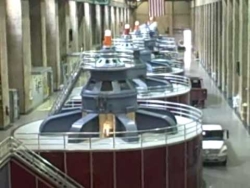
Pacific Northwest National Laboratory, Richland, Wash., is working with several partners to develop cold spray technology for repair of cavitation-damaged turbines in hydropower dams to improve performance and service life .
High direct costs are associated with repair and replacement of cavitation-damaged turbine blades. Not only are the costs high, but also typical repair methods such as arc welding introduce new weaknesses to the repaired turbine blades. High heat input and melting associated with arc welding degrade properties in and around the repair. This results in increased frequency of repair and reduced turbine performance compared to a new turbine.
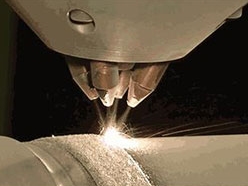
PNNL is researching cold spray as an alternative to arc welding repair. Cold spray works by shooting metal particles at supersonic velocities, or very high speeds. The impact energy created by these high speeds produces a solid state weld between the particle and the turbine surface. With this method, no melting or material degradation takes place, and the turbine blade is left in its original shape. Even better, cold spray repair is capable of depositing materials with hardness and wear resistance that match or exceed that of the turbine base metal—meaning cold spray repairs should produce superior performance.
“This project is generating the performance data and cost modeling to quantify the improved performance and value proposition of cold spray repair for hydro turbines, and the initial results are promising,” says PNNL researcher Ken Ross. The project team is confident that cold spray repair will dramatically reduce the frequency of dam outages, resulting in less down time and reduced service and maintenance costs for dams across the nation.
The Bonneville Power Administration funded a partnership between PNNL, the U.S. Army Research Laboratory, equipment manufacturer VRC, and Moog, a cold spray repair contractor. The Bonneville Power Administration, The U.S. Bureau of Reclamation, and Idaho Power are also part of the project team. Input from engineers, project managers, and economists from these organizations is being used to guide technical development and create a foundation for commercialization of this technology. This includes performance benchmarking data, cost modeling tools, best-practice documents, and a group of companies ready to provide equipment and tailor to needs of turbine repair.
http://energyenvironment.pnnl.gov/highlights/highlight.asp?id=2368