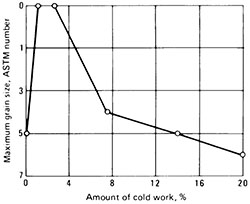
Larger amounts of cold work refine the grain size during solution treatment, but smaller amounts of cold work can lead to critical grain growth. The effect of varying amounts of cold work on grain growth in A-286 during solution treating is illustrated in the graph.
The initial material was solution treated with a maximum grain size of ASTM 5. Cold working in the range of 1 to 5% caused excessive grain growth during subsequent solution treating at 1650°F. Above about 5% of cold work, critical grain growth does not occur, and the recrystallized grain size decreases with increasing cold work. Excessive grain growth, especially excessive localized grain growth, would likely degrade tensile properties.
Therefore, on parts subjected to cold or hot work prior to solution treating, the critical amount of work (about 1 to 6% cold work, depending on the alloy, and about 10% hot work) must be exceeded in all areas to avoid the growth of abnormally large grains. This rule applies to parts such as cold-headed bolts, spun or stretch-formed sheets, and parts formed by simple bending.
Volume 4D, Heat Treating of Irons and Steels ⇒ Heat Treated High-Alloy Steels ⇒ Heat Treating of Precipitation-Hardenable Stainless Steels and Iron-Base Superalloys ⇒ Iron-Nickel Precipitation-Hardenable Superalloys