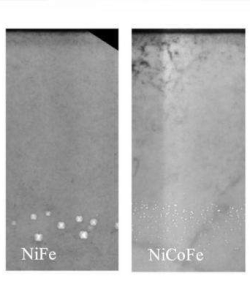
The University of Michigan, Ann Arbor, reports its researchers have discovered that nickel-cobalt-iron and nickel-cobalt-iron-chromium-manganese alloys in equal concentrations can be 100 times more resistant to radiation-induced swelling than pure nickel, meaning that radiation-induced cavities in these alloys are 100 times smaller than in pure nickel.
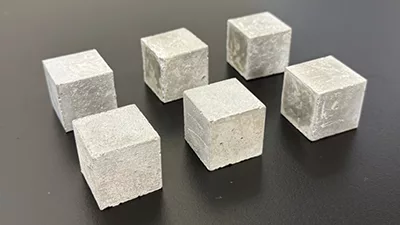
Colleagues at Oak Ridge National Laboratory in Tennessee created samples of a variety of nickel-based alloys. These were then exposed to radiation in a facility at the University of Tennessee. The most successful alloys were concentrated solid solutions—crystals made of equal parts nickel, cobalt and iron; or nickel, cobalt, iron, chromium and manganese.
“These materials have many good properties such as strength and ductility, and now we can add radiation tolerance,” said Chenyang Lu, a U-M postdoctoral research fellow in nuclear engineering and radiological sciences and the leading author of the report in Nature Communications.
In an experiment proposed by Dr. Wang, UT researchers exposed the samples to beams of radiation that created two levels of damage, similar to what may accumulate in a reactor core over several years and over several decades. These experiments were done at a temperature of 932°F, a temperature at which nickel-based alloys are usually susceptible to swelling.
These samples were analyzed at U-M’s Center for Material Characterization with a transmission electron microscope. The team found that compared to pure nickel, the best alloys had more than 100 times less radiation damage.
The study, titled “Enhancing radiation tolerance by controlling defect mobility and migration pathways in multicomponent single phase alloys,” appears in Nature Communications.
The work was supported as part of the Energy Dissipation to Defect Evolution Center, an Energy Frontier Research Center funded by the U.S. Department of Energy, Office of Science, Basic Energy Sciences.
http://phys.org/news/2016-12-safer-long-life-nuclear-reactorsmetal-resistance.html