Researchers and analysts from Penn State University, Case Western Reserve University, the GE Global Research Center, and Microsoft announce that they are working on a $1.5 million collaborative research project to develop a cloud-based wireless sensing and prognostic system for monitoring machinery health. The initiative will make it possible for the system to detect early signs of wear, aging. and fault conditions.
The federally funded Digital Manufacturing and Design Innovation Institute (DMDII) is providing $750,000 in funding, while the other four entities are matching that amount through a cost-sharing agreement.
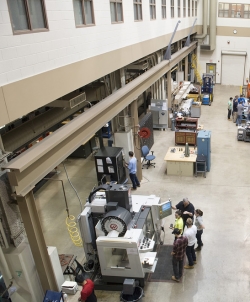
The project, called Cloud-Enabled Machines with Data-Driven Intelligence, is set to begin Feb. 1 and will be funded by DMDII for 18 months. The Factory for Advanced Manufacturing Education (FAME), which is housed within the Penn State IME department, is a 10,000-square-foot integrated high-bay laboratory for teaching and research, and is equipped with modern and legacy equipment. To demonstrate the cloud-based manufacturing systems with data-driven intelligence, both legacy machines and general-purpose computer numeric control machines will be used as test cases.
Dazhong Wu, senior research associate in the Harold and Inge Marcus Department of Industrial and Manufacturing Engineering (IME); and Janis Terpenny, professor and Peter and Angela Dal Pezzo Chair and Head of IME, all of Penn State, are the lead researchers of the project.
They are joined by Robert Gao, Cady Staley Professor of Engineering and chair of the Department of Mechanical and Aerospace Engineering at Case Western Reserve University; Li Zhang, senior research scientist for industrial Internet of Things (IoT) at GE Global Research Center; and Mark Beckmann, senior manager at Microsoft.
“The emergence of cloud computing, machine learning, and the IoT technologies makes it possible for a machine to function as an agent that is capable of intelligent behaviors, such as automatic fault and failure detection, self-diagnosis and proactive maintenance scheduling,” says Dr. Wu.
“The overall goal of this research is to establish a generic framework for real-time process monitoring, diagnosis, and prognosis for smart manufacturing using cloud computing and big data analytics,” says Dr. Wu. “The outcome of this project has the potential to enable manufacturers to implement artificial intelligence into manufacturing machines.”
DMDII was launched in 2014 through a collaboration with the U.S. Department of Defense and other partners to transform American manufacturing through digitization of the supply chain. The institute currently has more than 250 partner organizations from industry, academia, government, startups and community groups. DMDII is the first lab of UI LABS and is a member of the Manufacturing USA network.