Purdue University, West Lafayette, Ind., reports that its researchers have demonstrated the high-performance potential of an experimental transistor made of beta gallium oxide, which could bring new ultra-efficient switches for applications such as the power grid, military ships, and aircraft.
The semiconductor is promising for next-generation devices needed to control the flow of electrical energy in circuits. Such a technology could help to reduce global energy consumption and greenhouse gas emissions by replacing today’s less-efficient and bulky power electronics switches.
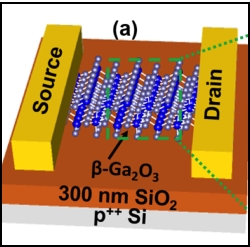
The transistor, called a gallium oxide on insulator field effect transistor, or GOOI, is especially promising because it possesses an “ultra-wide bandgap,” a trait needed for switches in high-voltage applications.
Compared to other semiconductors thought to be promising for transistors, devices made from beta gallium oxide have a higher breakdown voltage, the voltage at which the device fails, says Peide Ye, Purdue University’s Richard J. and Mary Jo Schwartz Professor of Electrical and Computer Engineering. The Purdue team achieved electrical currents 10 to 100 times greater than other research groups working with the semiconductor, added Prof. Ye.
The team also developed a new low-cost method in which adhesive tape peels off layers of the semiconductor from a single crystal, representing a far less expensive alternative to a laboratory technique called epitaxy. The market price for a one-centimeter-by-1.5-centimeter piece of beta gallium oxide produced via epitaxy is about $6000. However, the “Scotch-tape” approach costs pennies, and it can be used to cut films of the beta gallium oxide material into belts or nano-membranes, which can then be transferred to a conventional silicon disk and manufactured into devices, says Prof. Ye.
Findings are detailed in a research paper published this month in IEEE Electron Device Letters. Graduate student Hong Zhou carried out much of the research.
One drawback to the material is that it possesses poor thermal properties. To help solve the problem, future research may include work to attach the material to a substrate of diamond or aluminum nitride.