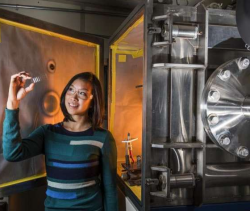
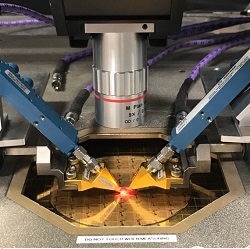
Sandia National Laboratory, Albuquerque, N.M., reports that its scientists have developed an aerosol deposition process in which ceramic nanoparticles form coatings when deposited at high speed at room temperature. Instead of high temperatures, this process is based on nanoparticles with high kinetic energy.
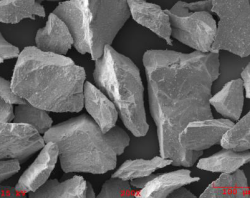
In the Sandia process, a nozzle accelerates room-temperature submicron particles suspended in a gas toward the surface. Particles impact and stick, building up a coating layer by layer. The process works because ceramic particles display plasticity at the nanoscale. Plastic deformation, or plasticity, allows a substance to permanently change size or shape under applied stress. The plasticity of submicron particles causes consolidation of subsequent deposition layers and generates the continuous surface that layers are built upon.
Another key is deposition in a vacuum, which helps alleviate the effects of reflected gases on the flying particles. Reflection of the high-velocity carrier gas from the deposition substrate can create so-called bow shock, a gas boundary layer that’s difficult for the smallest of particles to penetrate. But in a vacuum, reflected gases are diffused, so the bow shock layer is thinner. The smaller particles traveling fast have high momentum and can get through the thin bow shock layer. Without a vacuum, the bow shock layer is large and particles don’t have enough momentum to penetrate to the substrate.
By making high-velocity submicron ceramic particles slam onto surfaces at room temperature, Dr. Pylin Sarobol and colleagues avoid high temperatures. The kinetic process produces nanocrystalline films that are very strong and could serve as protective coatings against wear, corrosion, and oxidation. It could also efficiently build electronic circuits that combine hybrid materials or tiny capacitors or sensors.
“The ability to put down ceramics at room temperature means you can process ceramics and lower-melting temperature materials at the same time,” says Dr. Sarobol. “You can now put ceramics on copper, for example. Until now, you had to make the ceramics first, then put the copper down on it. This process is really about being able to integrate materials, especially ceramics, with other materials.”
https://share-ng.sandia.gov/news/resources/news_releases/kinetic_coatings/#.WLmr62_ytdg