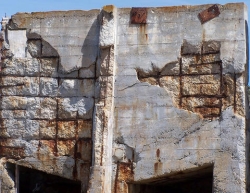
NIST, Gaithersburg, Md., announces that its scientists have developed a noninvasive “spectral fingerprint” terahertz radiation technique that reveals the corrosion of concrete-encased steel before it can cause any significant degradation of the structure it supports. The detection method is described in a new paper in the journal Applied Magnetic Resonance.
When water and oxygen corrode iron, different iron oxide products are produced, with the two most common being goethite and hematite. “The brown rust that forms when you leave a hammer out in the rain is mostly goethite, and when a steel reinforcing bar [rebar] corrodes inside a concrete bridge deck, that is mostly hematite,” says NIST physical chemist Dave Plusquellic. “We have shown in our new study with goethite, and our previous work with hematite, that terahertz radiation—electromagnetic waves with frequencies 10 to 100 times higher than the microwaves used to cook food—can detect both corrosion products in the early stages of formation.”
The NIST terahertz wave detection method works because goethite and hematite are antiferromagnetic. This means that the pairs of electrons sitting side-by-side within the iron atoms in these materials spin in opposite directions, leaving them unaffected by external magnetic fields. In contrast, the electrons in the iron atoms of a household magnet, which is ferromagnetic, spin in the same direction and are either attracted or repelled by external magnetic fields.
“Terahertz waves will flip the spin alignment of one of the electrons in a pair and get absorbed by hematite or goethite,” Dr. Plusquellic said. “Using a millimeter wave detector, we discovered that this antiferromagnetic absorption occurs only within narrow frequency ranges in the terahertz region of the electromagnetic spectrum—yielding ‘spectral fingerprints’ unique to goethite and hematite, and in turn, iron corrosion.”
With current advances in terahertz sources and detectors, the new NIST nondestructive evaluation technique has the potential to rapidly detect tiny amounts of iron-bearing oxides from early-stage corrosion of steel surrounded by concrete, polymer composites (such as pipe insulation in a factory), paints, and other protective materials.
“In the laboratory, we have demonstrated that a 2-milliwatt terahertz source can produce waves that detect hematite through 25 millimeters of concrete,” Dr. Plusquellic said. “Using terahertz sources with powers in the hundreds of milliwatts and state-of-the-art receivers with unprecedented signal-to-noise ratios, we should be able to penetrate 50 millimeters, the thickness of the concrete covering the first layer of rebar used in most steel-reinforced concrete structures.”
https://www.nist.gov/news-events/news