Pacific Northwest National Laboratory (PNNL), Richland, Wash., announces that its researchers have developed a method of extruding magnesium alloys that greatly improves their energy absorption by creating novel microstructures that are not possible with traditional extrusion methods. The process involves spinning the metal as it is forced through a tool to create a certain shape. It reportedly has the potential to reduce cost by eliminating the need for rare-earth elements, while simultaneously improving structural properties.
Researchers theorized that spinning the magnesium alloy during the extrusion process would create just enough heat to soften the material so it could be easily pressed through a die to fabricate tubes, rods, and channels. Heat generated from mechanical friction provides all of the heat necessary for the process, eliminating the need for power-hungry resistance heaters.
The PNNL team designed and commissioned an industrial version of their idea and received a one-of-a-kind, custom built Shear Assisted Processing and Extrusion machine — coining the acronym for ShAPE.
The billets of bulk magnesium alloys flow through the die in a very soft state, thanks to the simultaneous linear and rotational forces of the ShAPE machine. This means only one tenth of the force is needed to push the material through a die compared to conventional extrusion.
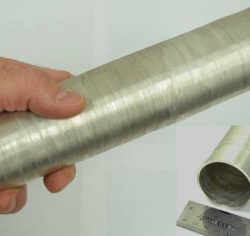
Engineers have successfully extruded very thin-walled round tubing, up to two inches in diameter, from magnesium-aluminum-zinc alloys AZ91 and ZK60A, improving their mechanical properties in the process. For example, room temperature ductility above 25% has been independently measured, which is a large improvement compared to typical extrusions.
This significant reduction in force would enable substantially smaller production machinery, thus lowering capital expenditures and operations costs for industry adopting this patent pending process.
“In the ShAPE process, we get highly refined microstructures within the metal and, in some cases, are even able to form nanostructured features,” says principal investigator and mechanical engineer Scott Whalen. “The higher the rotations per minute, the smaller the grains become, which makes the tubing stronger and more ductile. Additionally, we can control the orientation of the crystalline structures in the metal to improve the energy absorption of magnesium so it’s equal to that of aluminum.”
https://www.youtube.com/watch?v=rsjkZZv-irg