The Department of Energy’ s Lawrence Berkeley and Oak Ridge National Laboratories announce that a new concept in metallic alloy design – called “high‐entropy alloys” – has yielded a multiple-element material that has been demonstrated to be not only very tough at room temperature, but also strong and ductile at cryogenic temperatures. By definition, HEAs are multi-component alloys having at least five principal elements, and all the principal elements are mixed in equiatomic or close-to-equiatomic ratios.
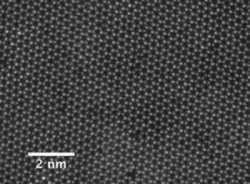
“We examined CrMnFeCoNi, a high‐entropy alloy that contains five major elements rather than several minor elements and one that dominates,” says Robert Ritchie of Berkeley Lab’s Materials Sciences Division. “Our tests showed that despite containing multiple elements with different crystal structures, this alloy crystallizes as a single phase, face‐centered cubic solid with exceptional damage tolerance. Furthermore, its tensile strength is above one gigapascal, and fracture toughness values are off the charts, exceeding that of virtually all other metallic alloys.”
Dr. Ritchie is the corresponding author, along with ORNL’s Easo George, of a paper in Science describing this research. The paper is titled “A fracture resistant high‐entropy alloy for cryogenic applications.” Co-authors are Bernd Gludovatz, Anton Hohenwarter, DhirajCatoor, and Edwin Chang.
“High‐entropy alloys represent a radical departure from tradition,” Dr. Ritchie says, “in that they do not derive their properties from a single dominant constituent or from a second phase. The idea behind this concept is that configurational entropy increases with the number of alloying elements, counteracting the propensity for compound formation and stabilizing these alloys into a single phase, like a pure metal.”
Although high‐entropy alloys have been around for more than a decade, it has only been recently that the quality of these alloys has been sufficient for scientific study. Dr. George and his research group at ORNL combined high‐purity elemental starting materials with an arc-melting and drop-casting process to produce high quality samples of CrMnFeCoNi in sheets roughly 10 mm thick. After characterizing these samples for tensile properties and microstructure, the ORNL team sent them to LBL for fracture and toughness characterization.
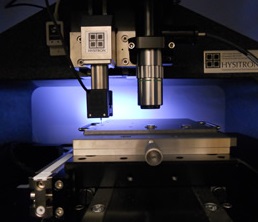
Tensile strengths and fracture toughness values were measured for CrMnFeCoNi from room temperature down to 77 Kelvins, the temperature of liquid nitrogen. The values recorded were among the highest reported for any material. That these values increased along with ductility at cryogenic temperatures is a huge departure from the vast majority of metallic alloys, which lose ductility and become more brittle at lower temperatures.
Researchers believe that the key to its remarkable cryogenic strength, ductility and toughness is a phenomenon known as “nano-twinning,” in which during deformation, the atomic arrangements in adjacent crystalline regions form mirror images of one another.