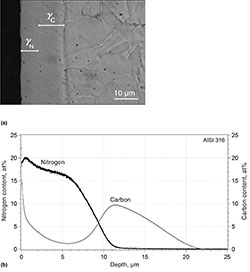
The graph shows (a) Micrograph of low-temperature nitrocarburized austenitic stainless steel AISI 316 in an atmosphere of (partly) decomposed urea (in situ activation). The sample was heated to 490°C (910 °F) in 45 minutes and thereafter immediately cooled.
(b) Glow discharge optical emission spectroscopy (GDOES) concentration-depth profiles of low-temperature nitrocarburized stainless steel AISI 316 in an atmosphere of (partly) decomposed urea; see microstructure in (a).
Nitrocarburizing in a carrier gas to which (initially solid) urea was added led to a fast growth of the expanded austenite zone. The gaseous decomposition products of urea that develop in the furnace are highly activating, which means that activation and nitrocarburizing are achieved simultaneously. The hardness measured directly at the surface (not in a cross section) is higher than 1300 HV. It is obvious that the expanded austenite zone consists of a nitrogen-rich and a carbon-rich part.
The near-surface zone consists of nitrogen-expanded austenite, and the carbon-expanded austenite is located underneath. The sum of the two interstitial profiles yields a gradual transition from the surface into the substrate in terms of total interstitial content.
Volume 4D, Heat Treating of Irons and Steels ⇒ Heat Treated High-Alloy Steels ⇒ Low-Temperature Surface Hardening of Stainless Steel ⇒ Gaseous Low-Temperature Surface Hardening of Austenitic Stainless Steel