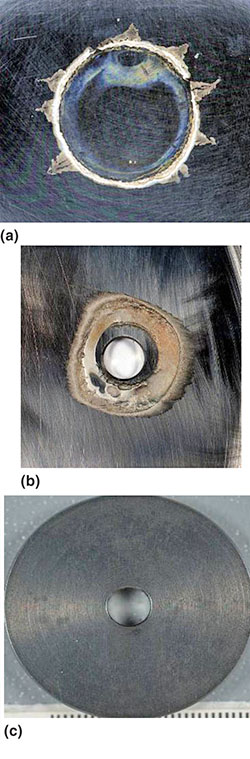
In crevice corrosion testing, treated 316 stainless steel compares favorably with alloy 625, as shown in the figure with three images. This figure shows three specimens at the end of a weeklong crevice corrosion test in natural seawater, at room temperature, under an applied potential of 300 mV.
- Alloy 625 did not initiate crevice formation until 60 hours had passed; at the end of the week, a 76.2 μm (0.003 in.) crevice cut was evident.
- Nontreated 316 showed initiation of a crevice in less than one hour. At the end of the week, a 1270 μm (0.050 in.) crevice cut with significant material wastage was experienced.
- The treated 316 specimen, however, showed no initiation in over 160 hours, and no sign of etching after this weeklong test. The suppression of crevice corrosion as a failure mode for 316 is an unexpected but important result.
Volume 4D, Heat Treating of Irons and Steels → Heat Treated High-Alloy Steels → Low-Temperature Carburization of Austenitic Stainless Steels → Performance Properties of the Low-Temperature Carburized Layer