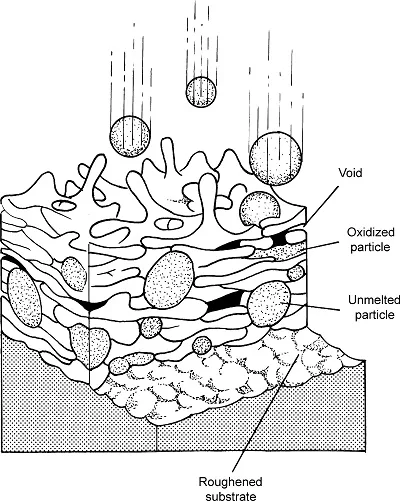
The image shows the typical lamellar (layered) thermal spray coating microstructure that results from particulate deposition. This unique microstructure imparts several disadvantages.
As with all coating technologies, thermal spray has some limitations. Understanding these limitations is important so that engineers can design effective solutions to the challenges of surface modification. Failures have occurred because coating and substrate limitations were not considered or were poorly understood.
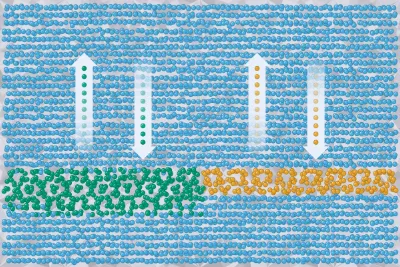
Thermal spray coatings generally exhibit some porosity, allowing the passage of gases and/or liquids through to the coating/substrate interface. Porosity is controllable down to levels below approximately 0.1% with most processes. Postdeposition treatments such as fusion, sintering, or hot isostatic pressing can decrease porosity and close up splat boundaries. Surface and interconnected porosity can be closed off using a variety of sealing methods, including anaerobic sealers, epoxies, phenolic sealers, and so on. Connected porosity is minimized by ng high-velocity oxyfuel, VPS, and cold spray processes.
Thermal spray coatings are inherently anisotropic in the as-sprayed condition. That issue is discussed elsewhere in this Volume.
Image – Thermal spray coating. Buildup of a thermal spray coating is a chaotic process. Molten particles spread out and deform (splat) as they strike the substrate, at first keying onto asperities on the substrate surface, then interlocking to one another. Voids can occur if the growing deposit traps air. Particles overheated in the spray jet can become oxidized. Unmelted particles may simply be embedded in the accumulating deposit.
This information is from ASM Handbooks Online, Vol. 5A: Thermal Spray Technology, Coating Structures, Properties, and Materials. To find this information (subscription required), click on the link below and scroll down to Figure 2.
https://dl.asminternational.org/handbooks/edited-volume/12/chapter/134972/Introduction-to-Coating-Design-and-Processing