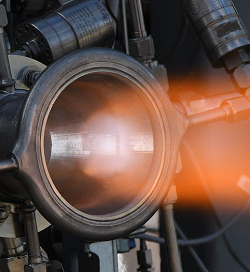
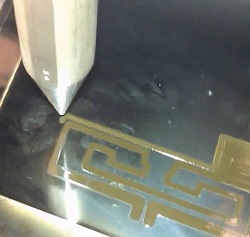
Engineers at NASA’s Marshall Space Flight Center in Huntsville, Ala., have reportedly developed and tested a new additive manufacturing technique called Laser Wire Direct Closeout (LWDC). The 3D printing method can be used to make rocket engine nozzles at a reduced cost in a shorter time. The 3D printing process is designed to precisely close out (seal) the coolant channels of the printed nozzle. These channels contain the high-pressure coolant fluid that protects the extremely thin walls of a nozzle from very high temperatures.
As the name suggests, LWDC is not a powder bed additive manufacturing process. Rather, the 3D printing technique is a process of freeform directed energy wire deposition to fabricate intricate metal parts. The technique has already been patented by NASA, and is reportedly capable of shortening fabrication times from months to just weeks.
According to the NASA engineers, the 3D printing process is designed to precisely “close out” the coolant channels of the printed nozzle. These channels contain the high-pressure coolant fluid that protects the extremely thin walls of a nozzle from very high temperatures.
NASA rocket engine nozzles are actively cooled, or “regeneratively” cooled, which means a series of channels is fabricated within the nozzle, and propellant later injected during the combustion cycle is routed through the nozzle to properly cool its walls. These channels, however, must be closed out (sealed) to contain the high-pressure coolant.
NASA’s new LWDC 3D printing process effectively seals up the coolant channels and forms a support “jacket” in place, reacting structural loads during engine operation.
“The motivation behind this technology was to develop a robust process that eliminates several steps in the traditional manufacturing process,” says Paul Gradl, a senior propulsion engineer in Marshall’s Engine Components Development & Technology Branch. “The manufacturing process is further complicated by the fact that the hot wall of the nozzle is only the thickness of a few sheets of paper and must withstand high temperatures and strains during operation.”